
Table of Contents
Externalized Insurance Rating Engine
Rating has always sat at the center of the policy lifecycle, it's the one calculation every quote, bind, and renewal depends on. Traditionally, that logic has lived inside the Policy Administration System (PAS), tightly coupled to issuance, endorsements, and renewals. That model still works for plenty of insurers. But as core systems multiply across business units, acquisitions, and product lines, more carriers and enterprise MGAs are evaluating externalized rating as an alternative to logic locked inside a single platform.
Several challenges are driving this shift:
- Multiple core systems: Many insurers operate several PAS platforms across business units, product lines, or acquisitions, resulting in duplicated rating logic that is expensive to maintain and difficult to govern.
- Increasingly complex program management: Enterprise MGAs and program administrators manage multiple carrier programs, each with unique pricing structures, delegated authority models, and capacity providers, making centralized insurance rating increasingly valuable.
- Growing integration requirements: Modern underwriting depends on third-party risk data such as property intelligence, catastrophe models, telematics, and credit data, requiring numerous reusable integrations often through an insurance rating API.
- High-volume digital distribution: Aggregators, embedded insurance partners, broker portals, and digital marketplaces generate thousands of quote requests that can place significant pressure on core systems if every request depends on the PAS.
As insurers scale, a real question arises: Does rating still belong in the core system, or is it becoming its own enterprise capability?
For a growing number of carriers and program administrators, the answer points toward an externalized insurance rating engine, separating pricing logic into an independent service that multiple systems, products, and channels can share. Separating pricing logic into an independent service lets multiple systems, products, and channels share one source of pricing, while core systems stay focused on policy administration. The interest in externalization isn't driven by technology trends, it's driven by the practical maintenance and integration challenges that compound as insurers scale.
What Is Externalized Rating?
Externalized rating is the practice of separating premium calculation from the core policy administration system and exposing it as an independent, API-accessible service. Instead of every application maintaining its own version of rating logic, multiple systems, a broker portal, an aggregator, a customer app, or the PAS itself call the same centralized rating service whenever a premium calculation is needed, and every consumer gets pricing from the same engine. This doesn't mean replacing the PAS.
It's the same pattern behind the rise of Skinny PAS and standalone Underwriting Workbenches: the PAS remains the System of Record, handling policy administration, endorsements, renewals, billing, claims interactions, and transaction processing. The externalized rating platform becomes the System of Intelligence for pricing, product configuration, and rating logic, evolving independently while staying connected through APIs.
This is also why the industry increasingly refers to Rating as a Service (RaaS): rating is consumed as a service rather than owned end-to-end inside one platform.
For Example:
Consider a health insurer launching a new product through a digital aggregator. Rather than embedding rating logic inside the core system, the insurer externalizes it instead. When a customer requests a quote, the aggregator calls the rating service via API, which calculates the premium using the insurer's centralized logic and returns it immediately. If the customer proceeds, the PAS receives the confirmed premium and continues issuance as normal, seamless for the customer and reusable for the carrier, since the same rating logic can now serve the aggregator, broker portals, and future channels without separate implementations.
What Business Challenges Can an External Rating Engine for Policy Administration Systems Solve?
Externalizing rating is not simply an architectural decision. For most carriers and enterprise MGAs, it is a response to specific business challenges that become increasingly difficult to address as products, distribution channels, and technology ecosystems expand. While every insurer's environment is different, there are several common scenarios where separating rating from the core system through an API-based insurance rating engine, delivers measurable operational value.
Managing Multiple Risk Data Integrations
Insurance pricing has evolved far beyond evaluating information provided by the customer during the quote process. Modern underwriting increasingly relies on external risk intelligence to assess exposures more accurately. Depending on the product, insurers may enrich quotes using catastrophe models, geospatial information, property intelligence, telematics, weather services, credit data, government databases, or other third-party risk providers.
The challenge is that every new data source introduces another integration. If rating remains tightly coupled with the core system, every additional integration often requires modifications within the policy administration system. As insurers launch new products or expand into additional lines of business, these integrations can quickly multiply, increasing development effort, testing cycles, and long-term maintenance costs.
Externalizing rating changes this approach. Instead of building separate integrations inside multiple systems, the externalized rating service becomes the central point for consuming risk data. With the Insillion Rating Engine, a Rater-to-API approach converts existing premium and rating logic, including the Excel models actuarial teams already use, into a reusable Insillion Rating API layer.
Third-party providers integrate once with the rating platform, allowing multiple applications to reuse those integrations through APIs. This creates a reusable architecture that becomes increasingly valuable over time. Rather than rebuilding integrations for every product or distribution channel, insurers can extend existing capabilities while reducing redevelopment effort and simplifying future enhancements. For insurers pursuing data-driven underwriting strategies, this flexibility enables new sources of risk intelligence to be incorporated without repeatedly changing the core policy administration environment.
Supporting High-Volume Quoting Without Impacting Core Operations
Digital distribution has fundamentally changed how insurers interact with customers and partners. Products are increasingly distributed through:
- Aggregators
- Broker portals
- Embedded insurance providers
- Affinity partners
That can generate thousands or even hundreds of quote requests within short periods. Travel insurance during holiday seasons, health insurance through comparison platforms, or group personal accident products offered via ride-sharing applications are all examples where quote volumes can increase dramatically. If every quote request depends directly on the core policy administration system, these spikes in activity may begin competing with the platform's primary responsibility of managing policy transactions.
Externalized rating helps separate these workloads. A dedicated insurance rating engine for complex calculations and high volume can scale independently, to process large volumes of premium calculations while allowing the policy administration system to continue focusing on policy issuance, endorsements, renewals, and servicing existing customers.
Cloud-native architectures further support this model by allowing computing resources to scale on demand during periods of peak activity before returning to normal operating levels when demand subsides. For carriers, this creates a more resilient architecture that supports business growth without requiring every increase in quote volume to translate into additional pressure on core systems.
Real-World Example: Scaling Embedded Insurance for Millions of Travelers
One example of this approach is Insillion's implementation for Royal Sundaram Insurance. To support embedded Group Personal Accident (GPA) insurance for passengers purchasing railway tickets online, insurance rating software for carriers like Insillion was integrated with the Indian Railway Catering and Tourism Corporation (IRCTC), one of the largest travel platforms in the Asia-Pacific region.
Built on AWS, the API-driven architecture enabled policy issuance at a massive scale, processing more than 30 policies per second and issuing over 640,000 policies in a single day. Because the rating capability operated independently from the carrier core system, Royal Sundaram was able to support extremely high transaction volumes without impacting the stability of its policy administration platform.
Simplifying Program Management Across Multiple Carriers and MGAs
Program administrators and enterprise MGAs often operate within highly collaborative insurance ecosystems. A single program administrator may manage:
- Multiple carrier relationships
- Delegated authority arrangements
- Capacity providers
- Reinsurers
- Distribution partners.
Each program may have its own pricing structure, underwriting rules, commission arrangements, and product variations. Managing these differences becomes increasingly challenging when each participant operates separate systems or maintains independent versions of rating logic. Introducing a new carrier, onboarding another MGA, or adding a new reinsurer can require additional integrations and duplicated configuration effort across multiple platforms. Externalized rating provides a centralized pricing layer that can support multiple programs while allowing each carrier or MGA to maintain its own rating configurations, overrides, and governance controls. A centralized rating layer gives program admins one place to manage this:
- Rate modifiers can be defined per channel partner
- Enable Insillion to support state-specific rating requirements with granular ZIP code-level and program-specific variations.
- Maker-checker approval workflows keep IT governance intact even as business teams make the changes directly.
For example, different MGAs can receive program-specific rates, while reinsurers maintain visibility into pricing rules and capacity arrangements. Distribution partners can continue using their preferred systems while consuming pricing through standardized APIs. This centralized approach reduces duplication, simplifies onboarding, and provides greater consistency across complex insurance programs without forcing every participant onto the same policy administration platform.
Eliminating Duplicate Rating Logic Across Multiple Core Systems
Many established insurers have grown through acquisitions, expansion into new markets, or the addition of new product lines. As a result, they often operate multiple policy administration systems across different business units. Although each system serves a distinct operational purpose, the underlying rating logic is frequently duplicated across them. When pricing changes occur, development teams may find themselves implementing the same update multiple times, validating each implementation separately, and coordinating releases across several systems.
Beyond increasing operational effort, this creates additional opportunities for inconsistencies between products and distribution channels. Externalizing rating address this challenge by creating a single enterprise rating service that every system can consume. Instead of maintaining rating separately inside multiple policy administration platforms, insurers maintain one centralized version of the rating logic through a headless insurance rating engine API.
- Policy administration systems
- Broker portals
- Customer portals
- Partner applications
- Future digital channels all consume the same pricing service through APIs.
This significantly simplifies change management. Business and underwriting teams can update pricing in one location while IT teams avoid coordinating multiple parallel implementations.
Training new resources becomes easier because there is one rating platform to understand rather than several disconnected implementations. Knowledge transfer and long-term maintenance also become more manageable. Rather than continually investing in maintaining duplicated functionality, insurers can focus their technology investments on building reusable capabilities that support future innovation across the enterprise.
When Externalizing Rating Doesn't Make Sense
While externalized rating offers significant advantages, it is not the right approach for every insurer or every product. The decision should be guided by business objectives rather than technology trends. If a carrier operates a single, API-enabled policy administration system that already meets its pricing, scalability, and integration requirements, externalizing rating may provide limited additional value. Externalization delivers the greatest benefit when it addresses specific business challenges, such as:
- Eliminating duplicated rating logic across multiple core systems
- Enabling enterprise-wide reuse of pricing capabilities
- Supporting high-volume digital distribution
- Simplifying integrations with multiple third-party data providers.
In other words, externalizing rating is not an end goal in itself. It is a strategic architectural decision that should be made only when it creates measurable business value.
Adapting Externalization to Your Business
Externalized rating isn't one architecture, it flexes to where a carrier already has investment:
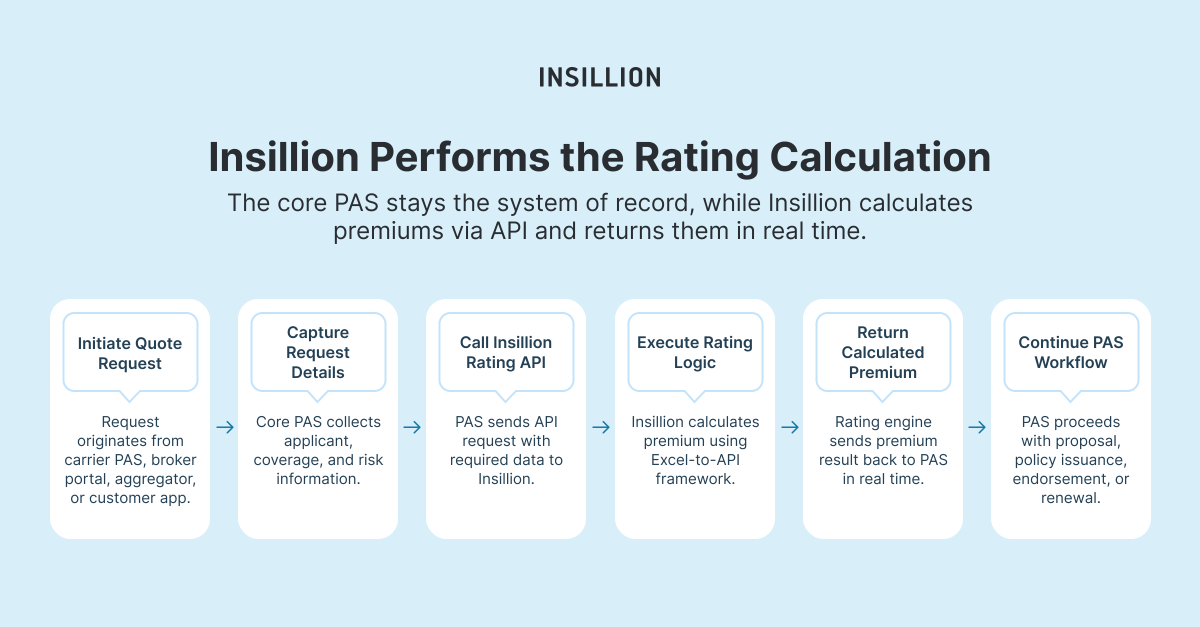
Model 1—Insillion performs the rating calculation
This model is well-suited for carriers looking to externalize rating without replacing their existing Policy Administration System. In this approach, the carrier's core PAS continues to manage the policy lifecycle, including:
- Quoting
- Proposal generation
- Policy issuance
- Endorsements
- Renewals
While rating logic is configured and maintained within Insillion’s low-code insurance platform. Existing Excel raters can be converted into APIs using Insillion's Excel-to-API framework, enabling the core system to request premium calculations as needed. Insillion acts as the external rating engine for policy administration systems, performing premium calculations and returning the results to the PAS in real time. The core system remains the System of Record, while Insillion becomes the centralized service responsible for pricing logic.
This enables carriers to maintain a single source of truth for rating across multiple systems and distribution channels without disrupting existing policy administration workflows.
Model 2—An external BRE or third-party rating engine performs the calculation
Many carriers have already invested in sophisticated Business Rules Engines (BREs) or third-party rating platforms that contain years of actuarial expertise, underwriting rules, and pricing logic. In these cases, replacing the existing rating engine may not be practical or deliver additional business value. Instead, Insillion’s API-driven insurance platform integrates with the carrier's existing rating platform. Insillion manages the:
- Digital customer journey
- Underwriting workflow
- Quoting
- Policy issuance
While premium calculation is delegated to the external BRE or specialized rating engine. Once the premium is returned, Insillion consumes the result and continues the policy workflow as the Policy Administration System without becoming the system that owns or maintains the rating logic. This approach allows carriers to preserve their existing investments in enterprise rating while modernizing customer experiences and policy administration around them.
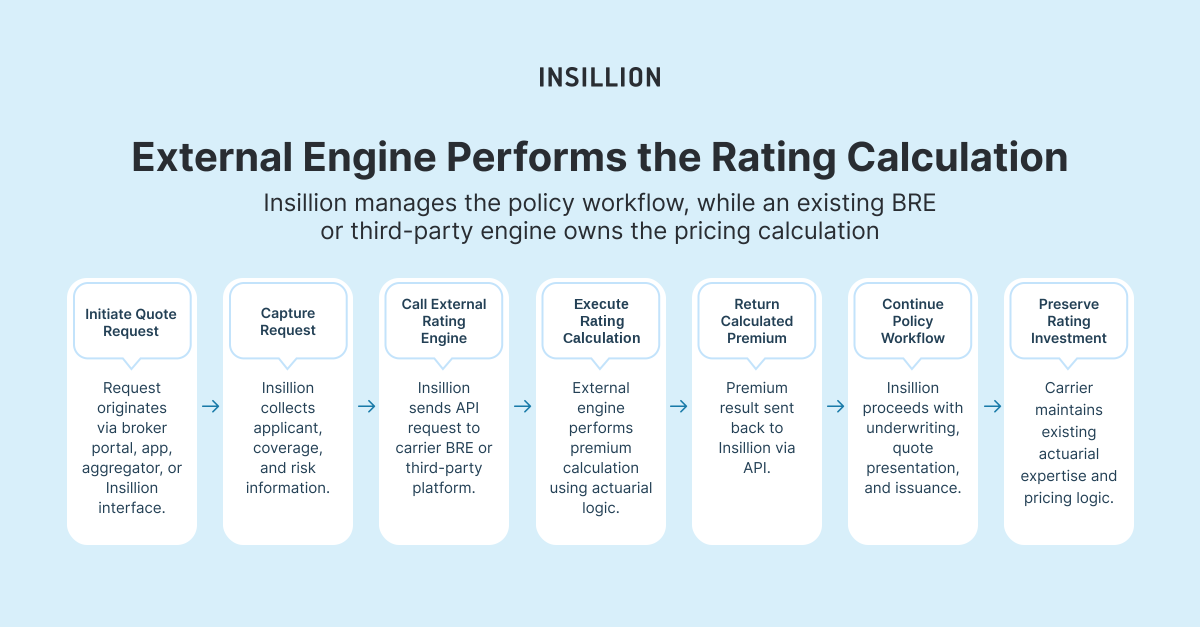 Ultimately, the right externalization model depends on the carrier's existing technology landscape, where rating logic already resides, and whether the primary challenge is duplicated pricing logic, integration complexity, or limitations within the current architecture.
Conclusion
Rating is increasingly treated as an enterprise capability rather than a function buried inside the core PAS. A centralized rating service can support the PAS, broker portals, aggregators, and other distribution channels through one consistent source of pricing logic.
That shift shouldn't be automatic. Externalizing rating is a business decision, not a technology upgrade for its own sake, it earns its place when duplication, scale, or channel complexity creates a real cost. The right decision isn't always to externalize. If an existing rating engine already supports the carrier's pricing, integration, and scalability requirements, continuing to use it may deliver the greatest business value.
Insillion helps carriers and enterprise MGAs externalize rating in a way that fits their existing architecture, without forcing a replacement of systems that already work.
Author Details

Articles
Recent Articles
Loading recent posts...
Stay updated on
what’s relevant
