

Insurance Workflow Management System
AI-Powered Efficiency for Insurance Workflows
Streamline repetitive and manual tasks by automating orchestrated workflows.
Submission Automation
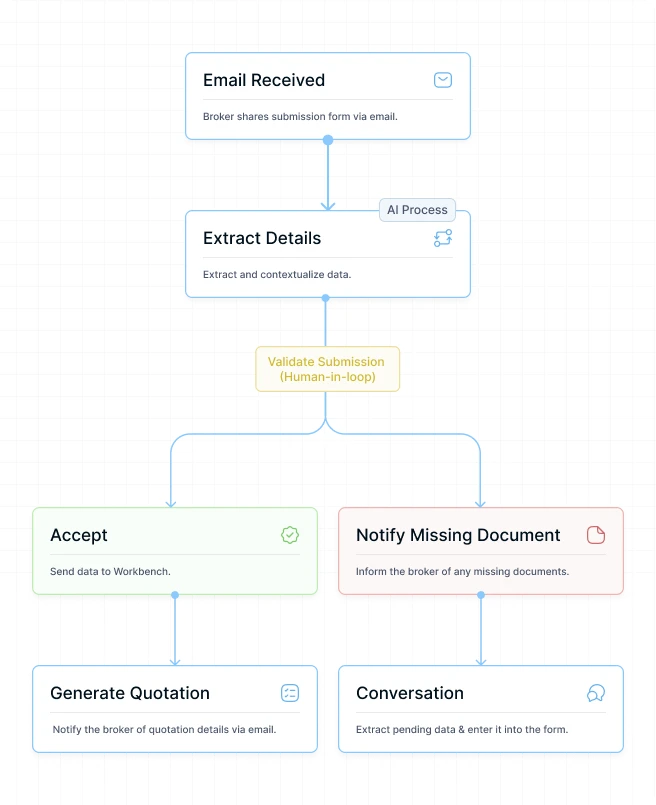
Bind more business with automated submission intake, where
InFlow extracts, validates, and processes submission data,
transforming emails and insurance forms into quotes within
minutes.

Faster Turnaround

Priority Allocation

Underwriting Rules
Claims FNOL Automation
Claims resolution starts with a seamless First Notice of Loss
(FNOL). InFlow automates FNOL intake, classification, and
triaging, reducing errors and minimizing delays.

Rule-based automation

Conversation

Omni-channel in-take
Workflow Automation in Insurance
Best of both worlds:
Underwriting & Automation
Combine underwriting expertise with AI-driven automation
for faster and more accurate underwriting outcomes.

In-Take
AI-powered data extraction to contextualize data from emails, spreadsheets, and PDFs.

Review
Validate in-take accuracy with human-in-loop.

Triage
Prioritize cases based on customizable rules to focus on high-value cases, instead of a first-in, first-out approach.

Rules
Enforce rules to trigger straight-through processing or underwriter review, for submissions and claims.
Business Orchestration and Automation
Insurance Workflow Orchestration
InFlow by Insillion bridges gaps in insurances processes like submissions and claims FNOL to reduce turnaround time.

Channels
Accept submissions and FNOL via email,
portals, or API integrations.

Multi-Language & Format Support
Extract data from PDFs, PNGs, JPGs, and other
formats in multiple languages.

Bulk imports
Automate bulk submission processing with
configurable triggers.

Notifications
Notify agents, brokers, and customers of
additional document requirements and status
updates.

LLM Agnostic
Choose between industry-leading AI Models for specific business needs.

Customizable Turnaround Times (TAT)
product type and underwriting needs.
Low Code Workflow Automation Insurance
Automation to Help Insurers Focus on What Counts
AI-driven automation to enhance the insurance experience across the entire value chain.

For Customers & Distribution Partners
Deliver faster turnaround and smoother
processes for loyal clients and partners.

For Underwriters
Improve underwriting experience and speed
by eliminating repetitive tasks, allowing
underwriters to concentrate on risk
assessment.

For IT teams
Keep your systems intact while layering Inflow
on top of what you already use; work with
existing data models or BYOD (Bring Your Own
Data) models.
Perspectives on Insurance Automation
What do MGAs & Carriers need to know about introducing AI into their workflows?
Our team shares practical insights on applying automation to core insurance processes.
Frequently Asked
Questions
Questions you might ask about our products and
services.
