
Table of Contents
MGA Insurance software
Multi-carrier capacity, the practice of working with two or more insurance carriers to place business, manage risk, and serve clients, is one of the most important structural advantages an MGA can build. It broadens available coverage, ensures competitive pricing, and prevents over-reliance on a single carrier's appetite or capacity limits.
As MGAs expand carrier relationships and launch new specialty programs, many are asking: Are there flexible MGA insurance systems for handling multiple carriers?
The answer increasingly lies in modern multi-carrier insurance platforms that centralize quoting, underwriting, carrier routing, and capacity management within a single environment. These Insurtech platforms specializing in multi-carrier insurance orchestration help MGAs scale efficiently without increasing operational complexity. But in practice, managing multiple carriers introduces real rigidity:
- Different rate structures
- Different underwriting rules
- Different forms
- Different approval workflows.
Without the right system, multi-carrier capacity means a bottleneck and risk. Multi-carrier insurance solutions are making multi-carrier capacity far more manageable and turning it into a strategic edge for MGAs that get it right.
This blog shows how modern MGAs can manage multi-carrier capacity efficiently.
Why do MGAs Adopt Multi-Carrier Models?
The core answer is simple: capacity and breadth of coverage. In practice, a single carrier may not fully cover every risk, location, or coverage requirement. An MGA's multi-carrier capacity allows MGAs to work with multiple insurance carriers rather than relying on just one.
As in the MGA 101 series, Somil Jain, Senior Actuary at Lewis and Ellis, notes, securing insurance capacity often resembles raising venture capital. Many capacity providers are willing to participate in a program but prefer a larger or more established carrier to lead the placement and perform the primary due diligence. These providers may only assume a portion of the overall risk, requiring MGAs to assemble capacity from multiple participants. This reality makes multi-carrier capabilities increasingly important, allowing MGAs to efficiently manage different carrier relationships while ensuring sufficient capacity for larger or more complex risks.
While this may sound like a structural or technical concept, its real value becomes clear when you look at day-to-day business scenarios.
- Overcoming Capacity Constraints: A broker bringing a $5 million deal to an MGA tied to a single carrier that can only support $2 million has two options: decline or lose to a competitor. By enabling access to multiple carriers, the MGA can distribute the risk and fulfill the entire requirement instead of turning business away.
- Geographic Reach: A client requiring coverage across 30 states can't be fully served by a carrier operating in 15. Without an insurance multi-carrier capacity setup, the MGA cannot service the full request. With it, they can extend coverage seamlessly across regions by leveraging different carriers.
- Varying risk appetites: Different carriers specialize in specific risk profiles, industries, and exposure levels. By working with multiple carriers, MGAs can match each submission to the most suitable carrier, improving both acceptance rates and pricing outcomes.
- Operational efficiency: From an operational perspective, configuring and managing multi-carrier products can be complex. However, when the setup is UI-driven, it simplifies product configuration and makes managing multiple carriers significantly more efficient.
One important structural reality: MGA must obtain a specialized license for a specific risk niche, say, cannabis businesses, chemical factories, or hospitality, and that license structure is largely identical across all MGAs in that niche.
Typically, a large portion of the product structure, often 70–80%, remains consistent across carriers, with only a smaller portion requiring carrier-specific customization.
This makes MGA multi-carrier capacity not just scalable but also operationally viable.
Single-Carrier vs. Multi-Carrier Solutions
| Aspect | Single-Carrier | Multi-Carrier |
|---|---|---|
| Capacity | Limited to one carrier's exposure limit | Distributed across multiple carriers |
| Geographic reach | Restricted to the carrier's operating region | Extended across regions via different carriers |
| Risk Appetite | One set of underwriting guidelines | Multiple appetites, better risk matching |
| Speed | Fast comparisons | Fast binding/issuance |
| Quote Handling | Simpler but less flexible | More dynamic, supports complex placements. |
| Scalability | Limited growth potential | Enables scaling across products and markets |
| Operational Complexity | Lower (but restrictive) | Higher, but manageable with automation |
| Coverage Options | Limited product and coverage flexibility | Broader and more customizable coverage options |
What Are the Possible Scenarios for Multi-Carrier?
Multi-carrier is not a one-size-fits-all approach. In practice, it operates through different models depending on the business need.
Scenario A — One Quote, Multiple Carriers
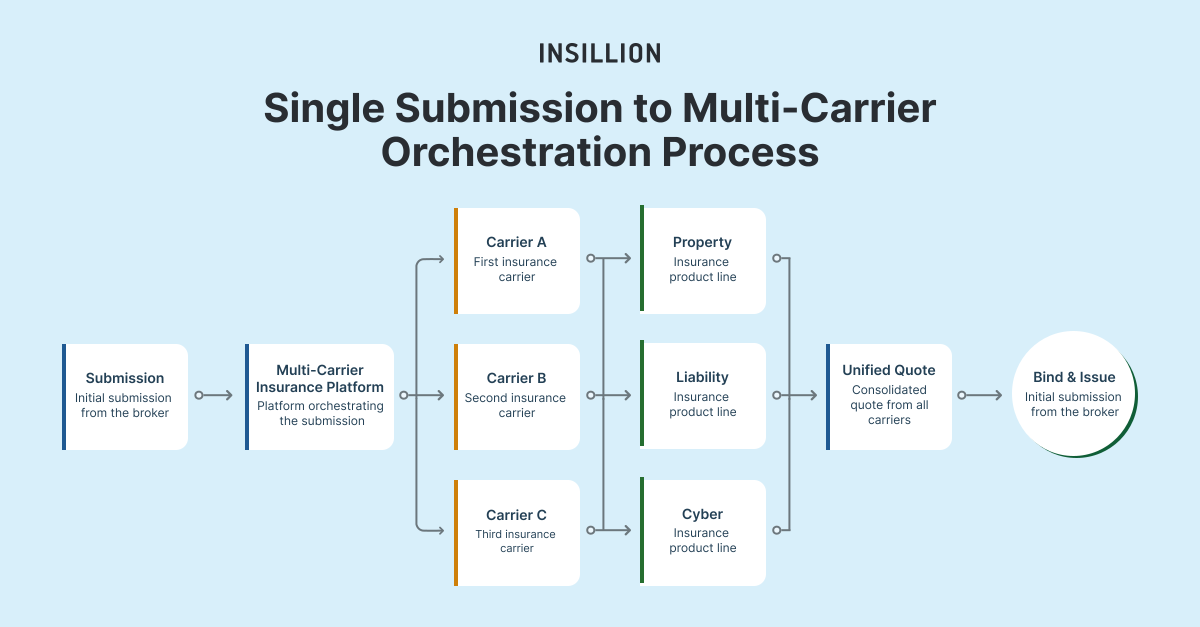
Here, a single client quote is broken down by coverage type, with each component routed to the carrier best suited for it.
Example: An MGA quotes a complex commercial package. The platform identifies that Carrier A is best for Property, Carrier B for General Liability, and Carrier C for cyber. The broker sees one unified quote, and the carrier split happens behind the scenes.
How it works:
- The platform internally dissects the unified quote into carrier-specific components
- A rules engine routes each component based on carrier guidelines, risk appetite, and pricing
- If a primary carrier declines a component (say, Cyber), the system re-routes that specific piece to a secondary carrier without restarting the entire submission
- Even if one carrier rejects their portion outright, the rest of the quote is returned to the MGA intact, so the broader opportunity is not lost.
Scenario B — Single Quote, Multi-Product, Single Carrier Placement
Sometimes referred to as the "Mother Quote" model, this scenario involves consolidating an entire client's insurance needs into one unified submission, comparing rates across multiple carriers upfront, and then placing the full package with one selected carrier.
How it works:
A broker requests coverage for multiple products, say, a commercial package policy, all for the same client. Instead of building separate quotes for each, the MGA bundles multiple, tailored coverage types, typically property and general liability, into one policy for medium-to-large businesses.
Unlike a Business Owners Policy (BOP), a CPP offers greater flexibility in policy limits, risk types, and, crucially, specialized, optional endorsements, simplifying management and reducing premium costs. The multi-carrier insurance solution then generates rate comparisons across available carriers.
The MGA reviews the options and selects the one carrier whose overall offering, pricing, terms, and coverage across all products combined is the most competitive.
Once selected, the entire package moves to that carrier for approval. Internally, the MGA insurance software splits the submission into per-carrier sub-quotes, each carrying its own premium, documentation, terms, and validations.
From there:
- Both carriers review simultaneously in parallel, with no cross-carrier dependency
- As soon as a carrier approves, the MGA can proceed with payment and binder issuance immediately
- If the chosen carrier rejects the full package, the MGA retains all original quote data, allowing them to quickly re-evaluate other carrier options that were initially presented or seek alternatives, preventing a complete workflow stoppage.
How Insillion Makes Multi-Carrier Easier
1. Smart Submission & Carrier Routing
A broker submits a single request. Insillion automatically splits it internally based on multi-carrier requirements, routing each portion to the appropriate carrier for parallel processing with no interdependencies between the two. In most current setups, carrier selection is still manual, with underwriters choosing the carrier, and default routing typically points to a primary carrier. However, multi-carrier insurance solutions support rule-based routing, where submissions can be automatically directed based on the following:
- Product type
- Location
- Coverage requirements
- Carrier appetite
For example: If product = Property and location = X, → route to Carrier A.
This type of intelligent routing is becoming a core capability of Insurtech platforms specializing in multi-carrier insurance orchestration, enabling MGAs to place business faster while improving carrier alignment and capacity utilization. Looking ahead, this can evolve into AI-driven carrier selection, further optimizing placement decisions.
-
Seamless Underwriting Experience
Carrier underwriters operate within the same multi-carrier insurance platforms, no need for separate portals. Submissions appear directly in their dashboard with automated notifications. Underwriters can approve, reject, raise queries, or apply loading all within one system.
The MGA underwriting workbench supports both STP (straight-through processing for submissions meeting all pre-defined conditions) and NSTP (routed to underwriters for review). This creates a unified and efficient underwriting workflow.
As in the MGA 101 series, Somail Jain points out, reinsurer oversight should not be viewed as a burden but as a valuable layer of protection. While oversight requirements vary, ranging from detailed reviews of initial policies to periodic audits, these controls help identify underwriting issues early and provide an additional level of expertise and accountability.
Multi-carrier insurance platforms support these governance requirements through audit trails, approval workflows, and transparent reporting, helping MGAs maintain strong carrier and reinsurer relationships.
-
Intelligent Rejection Handling
Rejections no longer disrupt the entire process.
- Partial rejection: The approved components are returned to the MGA, and the workflow continues
- Full rejection: The MGA retains the original quote data and can quickly re-evaluate alternatives
Future enhancements include automatic re-routing to secondary carriers, ensuring minimal business loss.
-
Independent Post-Approval Processing
Payment, binder issuance, and policy generation all happen independently per carrier, eliminating delays caused by cross-carrier dependencies.
-
Unified Product Configuration
Because the license structure for a given niche is largely the same across MGAs, about 70–80% of a product's configuration is reusable across carriers. Only ~20% are carrier-specific rating logic, underwriting rules, specific forms, and geocoding or limit parameters. MGAs typically build a base product and maintain carrier-specific versions or extensions on top of it.
One practical mechanism for this is the "Me Too" clause, where a carrier agrees to match or extend the terms of another carrier's product, reducing the need to build everything from scratch for each carrier.
-
Carrier Lifecycle Management
Onboarding a new carrier is a commercial negotiation, not a regulatory process. End-dating an outgoing carrier is straightforward, the carrier is end-dated in the system, and the incoming carrier is added with updated rates. No product rebuilds, no new portals. For mid-policy carrier switches, all data entered carries over with no re-entry required, though carrier-specific parameters need revalidation.
Industry experts have also highlighted that carrier participation is not always equal. As in the MGA 101 series, Somail Jain explains that some capacity providers prefer to follow a lead carrier rather than anchor a program themselves, contributing only a percentage of the overall risk. For MGAs, this means managing multiple carrier relationships is often a necessity rather than a choice, making efficient onboarding, reporting, and lifecycle management critical capabilities.
-
APIs & Data Security
The platform integrates through internal APIs (fetching rates based on carrier and cover name combinations) and external/CRM APIs (mapping client data to the best-fit carrier's rating logic). Bordereaux reports are generated using carrier-specific mappings and are exportable in preferred formats.
A non-negotiable requirement: strict data isolation. When quotes are sent to multiple carriers in parallel, Carrier A's rates are never visible to Carrier B.
Conclusion
Insurance multi-carrier capacity is fundamentally about capacity and coverage breadth. The real transformation happens when multi-carrier is automated and intelligently orchestrated: a single portal, a single product configuration, and intelligent routing underneath. MGAs that build this capability well don't just serve more clients, they operate with greater resilience, speed, and intelligence.
As MGAs look for the best MGA insurance software with multi-carrier integration in 2026, the focus is shifting toward platforms that can intelligently orchestrate multiple carrier relationships from a single environment. Solutions like Insillion is making that architecture automate much of the process, reducing manual errors and saving valuable time. These cloud-based multi-carrier insurance solutions can also integrate with various carriers' systems, providing a seamless interface for MGAs to manage quotes efficiently through a digital insurance software process.
Furthermore, multi-carrier insurance platforms enable agents to submit to multiple carriers simultaneously, significantly speeding up the process.
Frequently Asked Questions
Author Details

Articles
Recent Articles
Loading recent posts...
Stay updated on
what’s relevant
