
Table of Contents
Why Excel Still Powers Many Commercial & Specialty Insurance Products
For specialty, surplus, and commercial line MGAs, Excel isn't a stopgap, it's the tool of choice for rating logic that involves multiple inputs, intermediate calculations, and conditional tables. A single workbook can hold hundreds of formulas, lookup tables, and underwriting rules refined over years.
Many growing MGAs also run low-volume, high-value books, where building a custom rating application for every product is hard to justify, especially when business analysts already manage changes directly in Excel. Newer MGAs start even simpler, with underwriting guidelines living in spreadsheets or internal notes and a small team relying on manual review.
As policy volumes grow, endorsements become more frequent, and more underwriters join, these disconnected processes get harder to govern. For many organizations, converting Excel-based raters into APIs becomes the first step toward a more structured, scalable insurance platform.
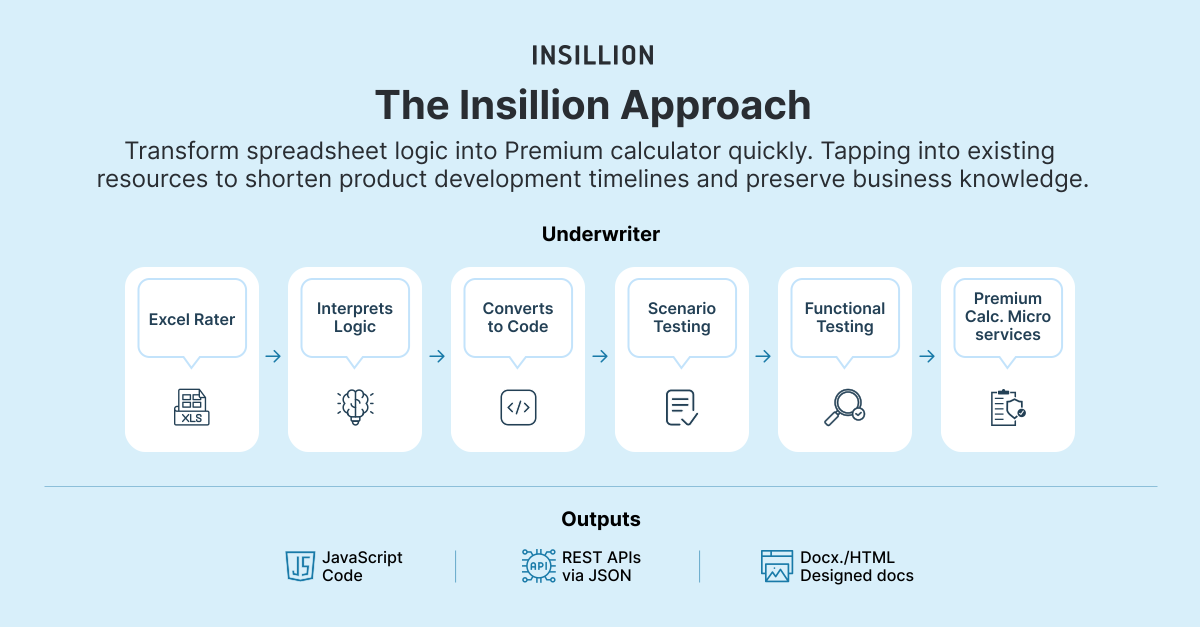
Why Insillion Excel-to-API Fits Commercial Lines: Commercial and specialty products see more frequent pricing updates, product variations, and state-specific requirements than personal lines. Rather than rewriting rating logic each time a product evolves, Insillion Excel-to-API preserves existing business logic and makes it available through modern digital channels.
Modernizing Excel Rating Models with Insillion Excel-to-API
For many MGAs, the challenge isn't creating a rating engine, it's making an existing one accessible to the rest of the business. Years of actuarial and underwriting knowledge already live in Excel, and rebuilding that logic elsewhere means additional cost, duplicate maintenance, and the risk of inconsistencies between the spreadsheet and the production system.
Insillion's Excel-to-API Accelerator takes a different approach: rather than replacing Excel, existing Excel raters become the foundation of a configurable insurance platform, where the same rating model can be exposed through APIs and reused across broker portals, customer portals, embedded insurance experiences, policy administration systems, and other digital channels.
A common requirement across MGAs and insurers is to retain the proven business logic already built in Excel while making it available as a secure, reusable insurance rater API that multiple applications can consume. Insillion's Excel-to-API Accelerator is designed to achieve exactly that, without requiring the rating logic to be rewritten.
The implementation is intentionally straightforward:
- Upload the existing Excel rater.
- Assign business-friendly names to input and output cells.
- The platform interprets the workbook, including its formulas and calculations.
- Excel inputs become JSON request parameters, and calculated outputs return as JSON responses
- Swagger/OpenAPI documentation is automatically generated, enabling faster, self-service integrations with downstream systems and partner applications.
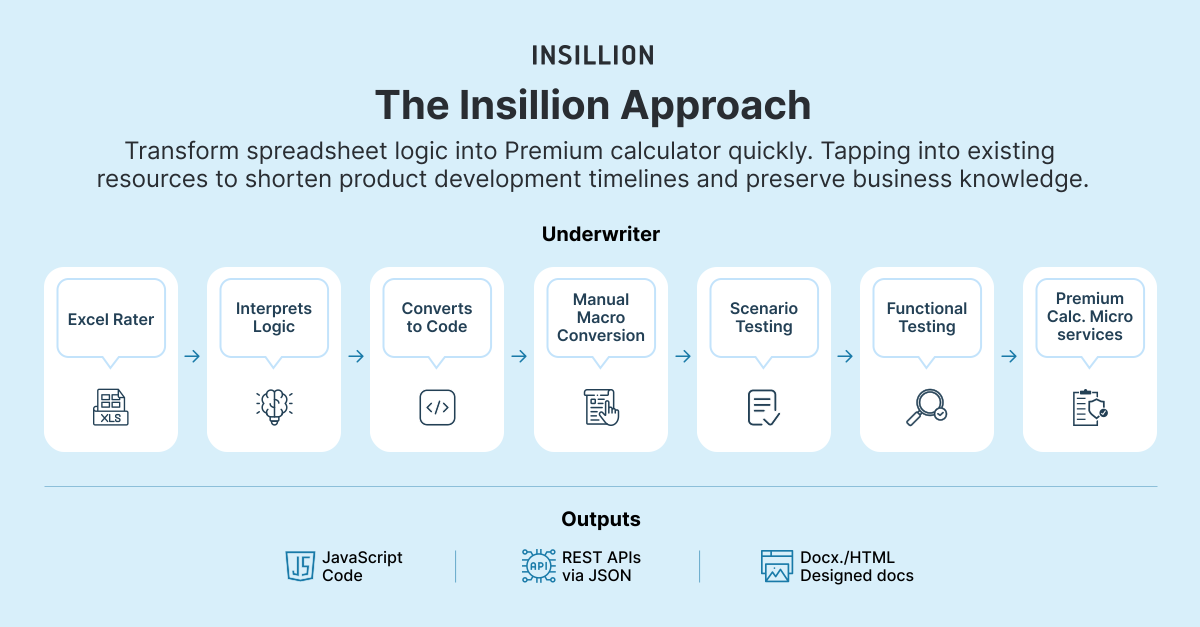
Because the rating logic is obtained from Excel, and maintained as a standardized API, there is no duplicate application logic to maintain. Business analysts continue managing pricing and underwriting logic in Excel, while developers consume standardized APIs. This lets insurers reduce product launch timelines and removes the traditional translation gap between business and IT, allowing product teams to update rating models without waiting for lengthy development cycles.
Choosing the right insurance rating architecture
The right approach depends on the product's complexity and data volume:
| Requirement | Recommended Approach |
|---|---|
| Stable rating logic managed by business users | Excel-to-API |
| Frequently changing rate tables | Excel + External Database |
| Large rule sets and enterprise underwriting | Business Rules Engine (BRE) |
| Existing enterprise rating services | External API Integration |
Beyond Rating: Turning Excel into a Complete Insurance Product
Converting Excel into an API is only the first step. A complete insurance product requires much more than premium calculation.
Insillion surrounds the Excel-based rating engine with configurable capabilities that help MGAs manage the entire quoting and policy lifecycle, from submission through endorsements and document generation.
Automatically Generated Broker and Agent Portals
Traditionally, developers must manually recreate ACORD forms in broker or agent portals, map every field to APIs, and maintain them alongside the rating engine. With Insillion's Excel-to-API approach, the Excel workbook itself becomes part of the product configuration. Using Excel Name Manager, business analysts define input and output fields, which are automatically reused as JSON request/response parameters and across the product.
This enables Insillion to automatically generate broker and agent portals with the required fields, eliminating the need to build forms from scratch. Insillion also supports AI-assisted submission intake, automatically extracting information from ACORD forms and supporting documents to create draft submissions for review.
The result is a complete, API-driven insurance product with portals, workflows, and integrations delivered with significantly less development effort.
Configurable Data Validation
Maintaining consistent data is just as important as calculating the correct premium. When an Excel rater is converted into an API, existing Excel validations continue to work as expected. Additional business validations, such as mandatory fields, conditional logic, data formats, and third-party data checks, can be configured without touching the workbook, and they're enforced consistently across the UI and API, ensuring secure, consistent data regardless of how the application is accessed.
Endorsements Using the Same Rating Logic
Business analysts define endorsement types, determine which policy fields are editable, and configure the required approval process. When an endorsement changes premium-bearing information, the platform automatically recomputes the premium using the same Excel-derived rating API, calculates any premium adjustment, generates the required endorsement documents, and maintains a complete audit trail. Insillion Excel-to-API ensures pricing remains consistent throughout the policy lifecycle without requiring separate rating logic for endorsements.
Rule-Based Policy Document Generation
Many MGAs continue to maintain policy forms and endorsements as Word documents. Insillion's Excel-to-API solution enables existing Word templates to be incorporated into the product configuration. Dynamic placeholders and configurable rules determine which forms or clauses are generated based on product, coverage, state, or underwriting conditions. The result is automated document generation while preserving existing policy forms and business rules.
Open APIs for Connected Insurance
The Excel-based rating model can be mapped to different user journeys, including the generation of Certificates of Insurance, without recreating the pricing logic for each one:
- A broker (B2B) journey might involve a detailed, multi-step submission process.
- A customer (B2C) journey might be simplified for direct-to-consumer use.
- An embedded insurance journey might require only a single-page workflow.
All three can run on the same underlying product configuration, and all of this is configured through a low-code interface, where business analysts can set up pages, sections, fields, and customer journeys. For Certificate of Insurance use cases, a master policy can support a self-service portal where clients like trucking companies issue their own certificates.
Managing Product Changes: Governance Built for Insurance
Rates change, guidelines evolve, and carrier requirements get updated regularly, the hard part isn't making changes, it's testing, approving, and deploying them without disrupting live business.
Draft, Compare, and Validate Before Anything Goes Live
When a new Excel version is uploaded, it's treated as a draft, not a live replacement. Business users compare it against the current production version and against historical quotes using the same input scenarios, so they can see exactly how premiums would change before anything goes live.
Regression Testing Using Real Quotes
Instead of creating test cases manually each time a product changes, the Insillion Excel-to-API solution allows MGAs to reuse actual quotation scenarios. Business users can:
- Save specific input scenarios, identified by submission ID, as test cases.
- Re-run those saved test cases automatically every time a new API version is uploaded.
- Select from previously generated real-world quotes to serve as official regression tests going forward.
Using real-world submission data makes regression testing faster, more reliable, and easier to repeat throughout the product lifecycle.
Maker-Checker Approval
A maker-checker process adds a review step before anything reaches production: a business analyst uploads and validates a new version, a senior underwriter or product owner reviews it, and only then is it published. This ensures that product updates follow a controlled governance process rather than relying on manual coordination.
Complete Version History and Audit Trail
Every published version is retained and linked to the quotes it generated, creating a permanent, immutable audit trail of the rating logic used for every quotation and policy. For MGAs managing products across multiple carriers or capacity providers, this level of traceability helps demonstrate pricing consistency, stronger underwriting discipline, and greater operational transparency during audits and carrier reviews.
Why Excel-to-API Is the Right Growth Path for MGAs and Small Carriers
- Optimized for scale – Insillion's hybrid approach delivers fast performance for large schedules, datasets, or complex lookup tables by storing large reference tables in a database while keeping business calculations in Excel.
- Faster regression testing – The production API runs the same logic defined in Excel, enabling quicker validation, higher accuracy, and reduced testing effort before deployment.
- No rebuild required – Underwriters simply identify the required input and output cells (using named ranges), and converts the spreadsheets into APIs while reducing product launch timelines.
- SOC 2 Type II certified: Protects rating models, data, and business logic with institutional-grade security controls.
- Supports large Excel raters: Insillion Excel-to-API supports workbooks up to 80–150 MB. Large lookup tables can optionally be moved to database tables while calculations remain in Excel, improving performance and reducing memory usage without a complete rebuild.
- Granular rate management: Supports agent, broker, territory, state, ZIP code, and program-specific rates. When these rate tables become too large or require frequent updates, they can be managed centrally in a database, while Excel continues to drive the calculation of logic.
Conclusion
Excel has been the foundation of insurance rating systems for decades because it allows business teams to build and maintain complex products quickly. The challenge has never been creating rating logic, it has been making that logic scalable, governable, and accessible across modern digital channels.
Insillion's Excel-to-API Accelerator closes that gap: existing Excel raters become APIs, surrounded by configurable workflows, portals, validations, document generation, and governance capabilities without rebuilding years of underwriting expertise. For MGAs and small carriers, that also means removing one of the most common causes of delayed launches, the manual handoff between the Excel workbook for the business trusts and the system IT has to build around it.
Author Details

Articles
Recent Articles
Loading recent posts...
Stay updated on
what’s relevant
