
Table of Contents
- Insurance Distribution Is Becoming More Digitally Connected
- Different Distribution Channels, Different Technology Requirements
- When Existing Systems Cannot Keep Up With Distribution Requirements
- How Insillion Enables IT Teams to Support Modern Insurance Distribution
- Extending Insurance Policy Administration Systems for Modern Distribution
- GIG Kuwait Takaful: Modernizing Distribution Without Replacing the Core
- Building a Flexible Foundation for Insurance Distribution
- Frequently Asked Questions
- Author Details
Insurance Distribution Is Becoming More Digitally Connected
Insurance distribution is no longer a single route between insurers and customers. Changing customer behavior, evolving regulations, and the growth of digital ecosystems are expanding how insurance products are discovered, purchased, and serviced. Insurers now distribute products through a broader mix of channels, including:
- Brokers
- Agents
- Bancassurance partners
- Aggregators
- Embedded insurance providers
- APIs and digital platforms
Each channel serves a different purpose and comes with its own operational and technology requirements. A broker handling a complex commercial quote needs structured data exchange and faster quoting, while an embedded insurance partner may need real-time APIs that allow coverage to be offered within an existing customer journey. This expansion also brings cost considerations. While personal insurance relies on straightforward digital journeys, commercial insurance demands complex submissions, intensive underwriting, and specialized servicing. As insurers explore new distribution models, they need ways to expand their reach without creating a separate technology stack for every channel.
The Asia-Pacific Insurtech market is projected to grow at a 16.2% CAGR through 2036, reflecting the broader shift toward technology-enabled insurance ecosystems. For insurers, this means distribution is becoming as much a technology challenge as a business strategy. According to Gartner, 70-80% of insurance IT budgets are consumed by legacy maintenance.
The technology supporting distribution needs to connect partners, support different customer and intermediary journeys, expose insurance capabilities through APIs, and handle varying transaction volumes, all while working with the systems that already run the insurer's business. As per McKinsey, delaying core modernization past 2026 creates competitive gaps in the insurance industry that traditional 18-month IT projects cannot reverse.
This is where insurance distribution software can provide a dedicated technology layer between existing insurance systems and the channels through which products are sold and serviced.
Different Distribution Channels, Different Technology Requirements
1. Brokers Need Faster Quoting Processes
For brokers, the quality and speed of the quote process can directly affect the insurer relationship. A commercial property or fire quote may include unstructured location details, while group insurance quotes can contain lengthy member-level information. Underwriting teams may need to manually extract, consolidate, and validate this information before they can assess the risk and prepare a quote. This slows down quote processing and may lead to missing or inconsistent data. Automated quote intake can help insurers capture information from these documents, structure the relevant data using IDP, apply validations, and move it into the appropriate underwriting workflow.
Accenture has highlighted that underwriting remains heavily reliant on paper-based and fragmented information, with proposal data often siloed across PDFs and spreadsheets. Digital connectivity can replace much of this manual exchange. A broker's system can submit structured information to an insurer, receive a quote, and track the progress of the quote without relying on lengthy email exchanges. For enterprise brokers and other distribution partners that already have front-end systems for capturing customer and risk information, the distribution system should be able to consume that data directly; so that partners can continue using their existing workflows and systems while connecting to the insurer platform through APIs, rather than switching between multiple systems to complete a transaction.
The objective is not simply faster quoting. Brokers also need visibility into whether a risk fits the insurer's appetite, what information is still required, and where the quote stands in the process.
2. Agents Need Better Access to Policy and Servicing Capabilities
Agents continue to play an important role in helping customers select and manage insurance products. Their technology requirements are therefore different from those of brokers. Agents need access to capabilities such as quotation, policy information, document retrieval, renewals, and routine servicing without depending on insurer operations teams for every request.
Assisted buy journeys can also allow agents to remain involved while customers complete parts of the form themselves. For example, an agent can initiate a quotation and share a link with the customer to provide additional information. The insurer can then apply configured business rules to determine the next steps in the journey.
This approach helps digitalize and automate routine activities while keeping agents involved in customer engagement and advice.
3. Digital and Embedded Insurance Partners Need Seamless Connectivity
Supportive regulatory frameworks and strong digital infrastructure, particularly in India and Southeast Asia, are accelerating embedded insurance adoption. Embedded insurance introduces a different requirement: insurance needs to become part of an existing digital transaction.
A travel platform may offer travel coverage during booking. A logistics platform may offer cargo insurance alongside a shipment. A financial platform may present insurance during a lending journey. In each case, the customer should be able to access insurance without being redirected into a separate process. This requires technology that can expose insurance capabilities, such as pricing, quotation, policy issuance, and document generation, through APIs and configurable embedded workflows.
The opportunity is significant. McKinsey estimates that embedded insurance in Asia could become a $270 billion market in GWP by 2030. For insurers, the ability to connect products to external digital ecosystems therefore becomes an important distribution capability.
4. Aggregators Create High-Volume Distribution Requirements
Aggregators and marketplaces introduce scale. A single partner can generate large numbers of quote requests, particularly for high-volume products such as motor insurance.
The supporting distribution technology needs to respond quickly and consistently while handling traffic spikes. This makes API performance, horizontal scalability, and efficient transaction processing particularly important. The challenge is ensuring that digital distribution can grow without making the existing policy administration system responsible for every interaction.
When Existing Systems Cannot Keep Up With Distribution Requirements
Most insurers rely on established systems for core functions like policy administration and underwriting. The challenge is that many were designed around managing the policy lifecycle rather than serving an expanding ecosystem of digital channels.
- As insurers add new distribution partners, the technology requirements surrounding the core become more complex.
- A broker may require an API for structured quotes.
- An agent may need a self-service portal.
- An aggregator may generate thousands of quote requests during a peak period.
- An embedded partner may need real-time pricing and policy issuance within its own application.
When every new requirement has to be implemented directly within the core, several problems can emerge:
- Limited API connectivity: Existing systems may not expose insurance capabilities in the format required by digital partners.
- Channel-specific development: Different partners may require separate interfaces, workflows, and validation rules.
- Manual data rekeying: Information captured through external channels may still need to be re-entered into core systems.
- Longer implementation cycles: New products and distribution configurations can require significant development and testing, delay launches, and potentially cause carriers to miss business opportunities.
- Growing integration footprint: Adding more partners and channels can increase the number of integrations IT teams need to maintain, making the technology environment harder to evolve efficiently.
- Core system load: High-volume digital transactions can put additional pressure on systems responsible for core policy administration.
The impact is ultimately felt by both the insurer and its distribution partners.
- Brokers wait longer for responses.
- Agents depend more heavily on internal teams.
- Digital partners face longer integration cycles.
- Customers encounter fragmented journeys.
- And IT teams spend more time maintaining channel-specific solutions instead of enabling new business capabilities.
What Insurers Need From Insurance Distribution Software
These challenges create a need for distribution technology that can support multiple channels without placing every new requirement on the core system. A top insurance distribution platform for policy administration modernization should address the operational requirements created by multiple channels while working alongside existing insurance systems.
To bridge this gap effectively, insurance carriers need:
- API-first architecture to expose insurance capabilities to brokers, aggregators, embedded partners, and digital applications.
- Channel-specific configurability so different partners can have tailored journeys, forms, validations, and business rules.
- Self-service capabilities for brokers, agents, customers, and other users.
- Straight-through processing for eligible, low-complexity quotes.
- Real-time visibility into submissions, quotations, policies, and servicing activities.
- Scalability to handle high transaction volumes without transferring every digital interaction directly to the core.
Together, these capabilities create a distribution layer that can evolve as channels and partner requirements change.
How Insillion Enables IT Teams to Support Modern Insurance Distribution
Insillion is designed to help insurers create and extend distribution capabilities while working with their existing core system. Insillion operates as a product and distribution layer between the existing system of record and the channels through which insurance is sold and serviced. Insurance distribution software gives IT teams a way to support new distribution requirements while maintaining the existing core architecture. In the Asia-Pacific region, Celent’s latest data indicate that IT spend is projected to grow by nearly 14% in 2026.
1. Create and Manage Products for Multiple Distribution Channels
Insillion provides a unified product foundation that allows insurers to configure a product once and support it across multiple distribution channels. The same underlying product logic, rules, and calculations can be reused across broker, agent, customer, aggregator, and embedded journeys, while each channel can have its own experience, validations, and workflow. This means insurers don't need to maintain separate versions of the same product for every distribution channel.
For IT teams, this creates a single codebase and a more consistent product architecture, making changes easier to manage and reducing the maintenance effort that comes with channel-specific implementations. When a product needs to evolve, changes can be made to the common product foundation and then applied across the relevant channels, while channel-specific requirements can still be configured where needed.
This leads to a more scalable approach to distribution: insurers can launch the same product through new channels faster, maintain fewer separate implementations, and reduce the complexity of supporting an expanding distribution ecosystem.
2. Enable Faster Broker Connectivity and Quote Processing
Insillion can support broker-facing journeys that capture structured quotes of information, validate data, route quotes through configured workflows, and provide visibility into quote status. The platform's API-first architecture also supports direct data exchange with broker systems and other external applications, creating a more connected submission process.
3. Digital Portals for Agents, Brokers, and Customers
Insillion can generate portals for different users, including underwriters, brokers and agents. Each portal can be configured based on the user's role and the product they work with. For example, a broker and an agent can have different screens, workflows, and access even when they are working with the same product.
For standard distribution journeys, insurers can use Insillion's configurable portals. When a partner needs a completely different digital experience, Insillion's APIs can be used to connect the product to a custom front end.
4. Connect Digital and Embedded Partners Through APIs
Asia-Pacific’s embedded insurance market will be the fastest-growing by 2035, with an estimated CAGR of 20.7%. Insillion automatically generates APIs as products are configured, allowing insurers to expose capabilities such as premium calculation, policy issuance, and communications. The scale of the opportunity is significant, with embedded insurance representing a projected $722 billion market opportunity by 2030. Early adopters capture incremental revenue and strengthen brand relevance.
The underlying cloud architecture is also designed to scale with transaction volumes, helping insurers handle high-demand periods and support large-scale digital distribution without placing unnecessary load on the core system.
5. Support Scalable Digital Distribution Without Overloading the Core
Digital distribution can create significant transaction volumes. If every quote request, partner transaction, or digital interaction has to travel directly through the core, the core can become a bottleneck. A distribution layer can help separate digital transaction processing from the underlying system of record.
Case Study: Insillion enabled Royal Sundaram General Insurance to integrate with IRCTC Asia-Pacific's largest ticketing platform, issuing 500,000 embedded Group Personal Accident policies daily.
Insurance distribution software allows insurers to continue using their existing core capabilities while introducing a more flexible layer for digital products, workflows, integrations, and distribution experiences. The approach is particularly relevant for high-volume products and digital channels where transaction volumes can fluctuate significantly.
Insurance distribution software also provides IT teams with greater flexibility to introduce new distribution capabilities without requiring every change to be implemented directly inside the core.
Extending Insurance Policy Administration Systems for Modern Distribution
According to McKinsey’s Insurance practice, carriers that have completed core system transformation report a 15–25% reduction in operating expenses within 3 years of go-live, making modernization one of the highest-ROI initiatives. Insillion's approach to modernization isn't to replace core systems, it's a middle-office layer that sits between the existing core and the distribution channels.
A More Flexible Modernization Architecture
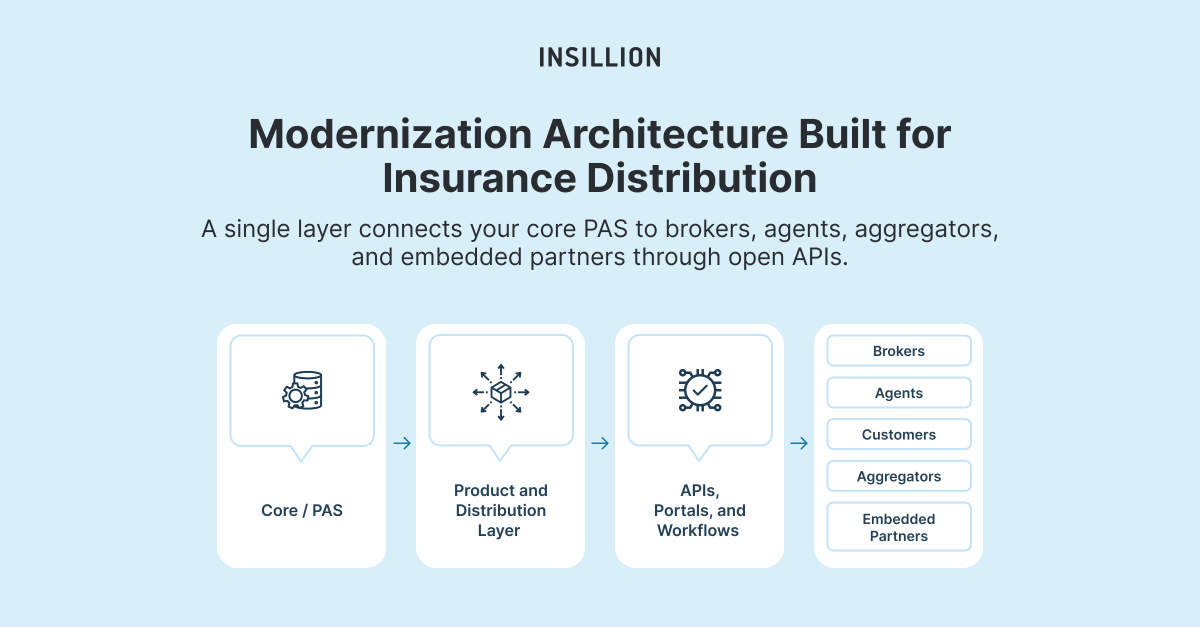
This approach allows insurers to modernize incrementally. It's built to co-exist with an insurer's existing systems or run standalone. What insurers can extend without a core rebuild:
- APIs and integration capabilities
- Partner portals
- Configurable product capabilities
Together, these capabilities create a flexible digital distribution layer above the existing PAS. It can help streamline operations and support faster product and rate changes, allowing carriers to react to social inflation, climate-driven CAT events, and shifting regulatory demands. It also improves experiences for both distributors and customers through self-service portals, embedded digital journeys, and real-time access.
McKinsey's Global Insurance Report 2025 identifies technology-driven distribution and digital connectivity as defining forces in how carriers now reach customers and compete.
Building a Flexible Foundation for Insurance Distribution
Insurance distribution is becoming more connected, but insurers don't need to rebuild their core systems to keep up. Modern insurance distribution software like Insillion can extend existing systems with the APIs, portals, and workflows needed to support different partners and channels. For IT teams, this means adding new products and distribution channels without creating a separate implementation for each one. For brokers, agents, and partners, it means faster transactions, better visibility, and the ability to work through the systems they already use.
A distribution layer that works alongside the existing core gives insurers a practical path to modernize distribution, expand channel reach, and scale without starting from scratch.
Frequently Asked Questions
Author Details

Articles
Recent Articles
Loading recent posts...
Stay updated on
what’s relevant
