
Table of Contents
MGA Insurance Software Evolution
The Managing General Agent (MGA) market is expanding rapidly. U.S. MGAs wrote about $102 billion in premiums in 2023 (up ~13% YoY vs. 10% industry growth). Despite this growth, MGAs face increasing scrutiny from capacity providers on underwriting discipline, loss ratios, and operational transparency. The MGAs that will sustain growth are those that can demonstrate not just speed but also consistency and control, and their technology stack is central to that proof.
For MGAs, speed to market is not just about launching products faster, it can determine whether they secure carrier capacity at all. As in Insillion's MGA101 Educational Video Series, featuring John Willemson, founder-CEO of Willemsen Advisors LLC, formerly of Accelerant, Arch Re & Munich Re, highlights that MGAs often have only one opportunity to make a strong impression with carriers when pitching their idea.
At that stage, they are expected to show more than intent, they might need a working prototype that demonstrates their underwriting approach, product construct, rating logic, and operational readiness. However, building these capabilities from scratch can be time-consuming and capital-intensive, often slowing down momentum when speed matters most. MGAs, therefore, need the ability to rapidly translate their business concept into a functional, carrier-ready demonstration without burning excessive time or resources.
This is where insurance software and end-to-end policy management platforms like Insillion become critical. In a market where carrier attention is limited and second chances are rare, technology readiness can be the deciding factor between securing capacity and losing the opportunity entirely.
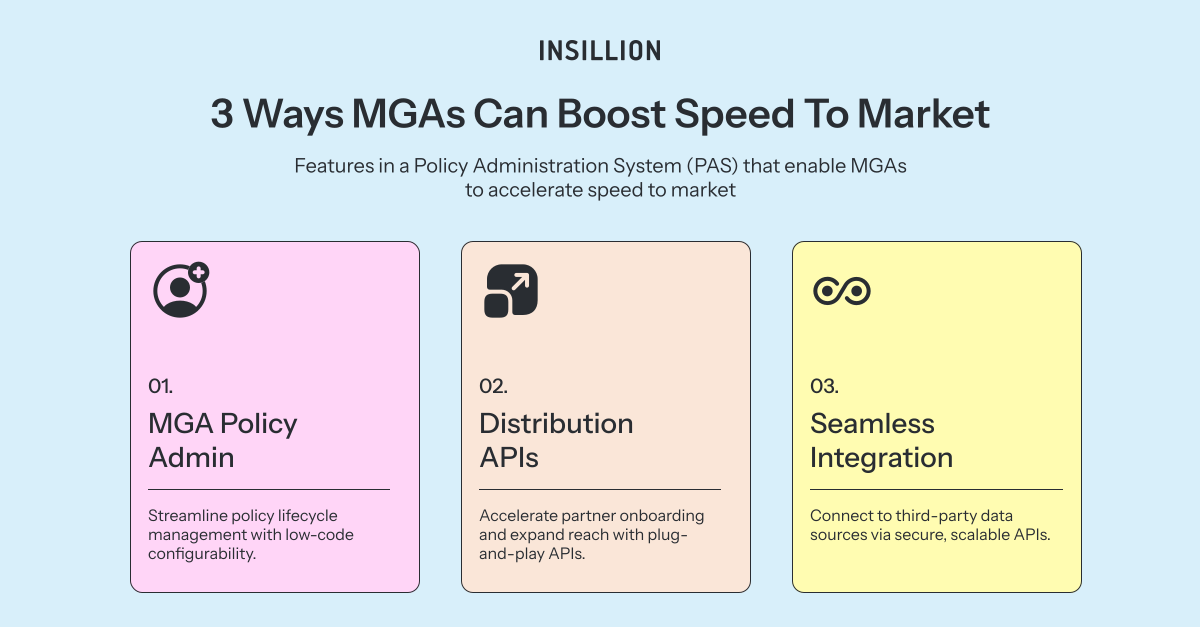
The MGA market is booming, driven by hard market conditions and a growing demand for niche coverage. These trends have created underserved market segments that MGAs are well-positioned to serve. Insurance Software for MGAs is equipped with advanced technologies that help MGAs accelerate speed to market and enable seamless distribution with partners.
Why Speed to Market Matters for MGAs:
- First-mover advantage
- Enhance competitive edge through rapid product launch
- Capitalizing on Niche Opportunities
- Regulatory and Market Changes
- Carrier & capacity provider expectations
MGA/MGU Policy Admin System
MGAs need the agility to make rapid product changes, and a flexible Policy Administration System (PAS) is the key. By eliminating lengthy development cycles, a modern PAS lets MGAs launch products faster using their existing actuarial models. While building proprietary technology can be time-consuming, an out-of-the-box solution significantly shortens implementation.
Automation and Straight-Through Processing (STP) streamline the entire policy lifecycle, reducing manual tasks and speeding time-to-market. Cloud-based MGA policy administration systems are scalable, making it easier for MGAs to expand into new markets or handle growing business volumes.
MGAs need their P&C policy admin systems to handle billing and commission logic natively, not through disconnected spreadsheets or manual reconciliation. For example, Insillion's integration with billing partners reflects this reality: the back-office financial workflow is as critical to MGA operational efficiency as the front-end quoting and binding experience.
Some MGA/MGU policy admin systems, like Insillion, come with a 180-day free sandbox and a "pay-as-you-grow" enterprise MGA insurance software cost pricing model, allowing MGAs to build, test, and refine products before going live. Product launches can typically be completed in as little as 3–8 weeks, helping MGAs capitalize on market opportunities faster
Distribution APIs
There's no one-size-fits-all approach to insurance distribution, and APIs have become essential for MGAs aiming to accelerate speed to market. Insurance distribution software uses APIs to connect PAS platforms with broker portals, aggregator sites, B2B2C partners, and other external systems. This enables MGAs to streamline interactions with distribution partners and bring new products to market more quickly across multiple channels.
For growth-stage MGAs, these same API capabilities also support embedded insurance models, allowing products to be integrated into travel, e-commerce, fintech, and affinity partner ecosystems. As a result, MGAs can extend their reach to new customer segments without building entirely new MGA distribution software.
With insurance distribution software for MGAs like Insillion, uploading an Excel rater automatically generates B2C/D2C portals and provides access to 300+ prebuilt APIs, enabling distribution capabilities to launch alongside the product rather than as a separate initiative.
At the core is Insillion's Insurance Rater-to-API approach, which converts Excel-based pricing models into scalable, API-accessible rating software. This allows MGAs to deploy the same pricing logic across carriers, brokers, partners, and digital channels without rebuilding integrations or duplicating rating rules. The result is faster product launches, consistent pricing, and a scalable distribution framework that grows with the business.
The best MGA insurance software for specialty programs doesn't need to be rebuilt from scratch for every product. The MGA insurance software helps MGAs manage broker relationships more efficiently while supporting growth across multiple programs. By reducing manual effort and administrative complexity, it enables lean teams to launch and manage products faster, even when operating across several lines of business.
Seamless Integration
For MGAs handling high submission volumes, integration also means cleaner data at intake. Connecting directly to broker systems and third-party data sources reduces manual re-entry, cuts error rates, and speeds up the quote-to-bind cycle, directly impacting loss ratio outcomes downstream.
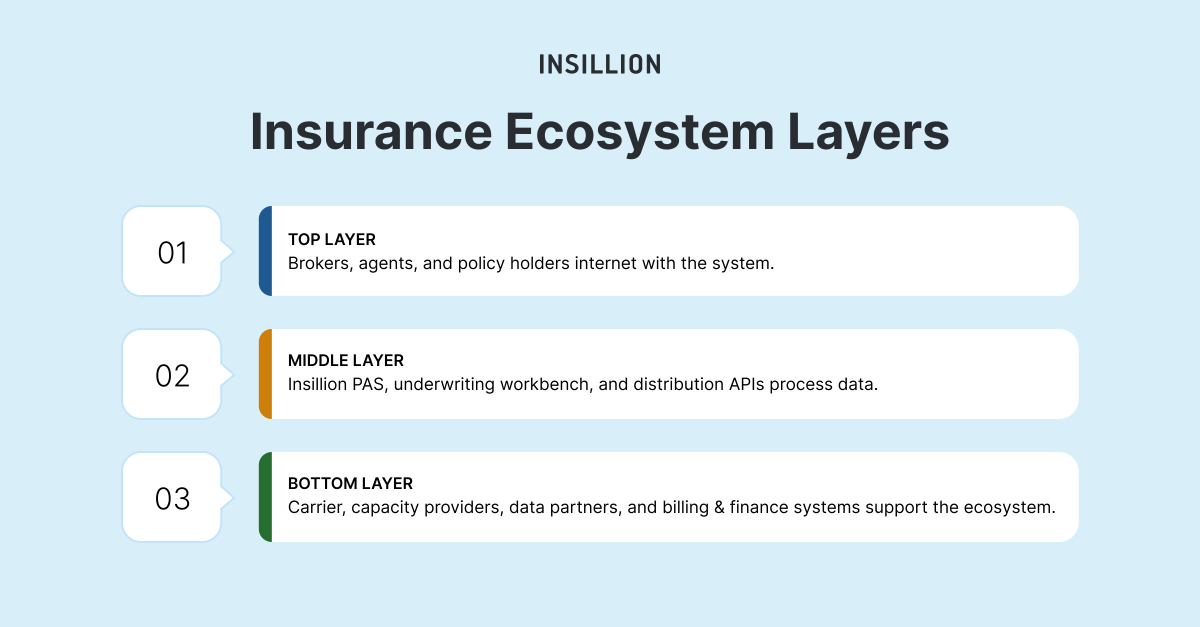
An MGA operates at the center of a complex network, connecting carriers, agents, brokers, and policyholders. Seamless integration means the MGA insurance software can communicate with partner platforms in real time, enabled by APIs. Information is exchanged automatically and in real time.
Beyond basic connectivity, modern MGA software provides:
- A library of pre-built integrations with CRMs
- Accounting systems
- Claims platforms
- Data providers
- Billing solutions
- Externalized rating engines
APIs also support embedded insurance use cases, such as travel protection during booking or warranties at checkout, and connect with inspection and verification services for pre-policy risk assessments.
With a pre-built partner ecosystem, MGAs can quickly assemble the technology stack they need without relying on lengthy custom integration projects, accelerating implementation while reducing operational complexity.
As MGAs scale, they often work with multiple carriers and capacity providers. Modern MGA platforms support:
- Multi-carrier product structures
- Bordereaux reporting
- Carrier approval workflows
- Centralized program management
Together, these capabilities power integrated ecosystems, making seamless integration essential for achieving true speed to market.
Identifying Insurance Software for the Modern MGA
Choosing the right SaaS insurance software is a critical part of an MGA's go-to-market strategy. Insillion's inclusion in the Datos Insights 2026 Underwriting Workbench Market Navigator reflects its growing relevance for MGAs seeking flexible, scalable underwriting automation without the complexity and cost of enterprise-scale implementations.
For MGAs focused on bringing new products to market efficiently, Insillion provides a purpose-built PAS platform that minimizes upfront technology investment while supporting long-term growth. By combining configurable product setup, AI-powered submission intake, workflow automation, API-driven distribution, and a pre-integrated partner ecosystem, the platform streamlines the path from product concept to market launch.
Insillion enables MGAs to rapidly configure products, implement underwriting and rating rules, generate policy documents, and build carrier-ready prototypes. This helps organizations demonstrate operational readiness, reduce implementation complexity, and move from idea to execution with greater speed and confidence.
Frequently Asked Questions
Author Details

Articles
Recent Articles
Loading recent posts...
Stay updated on
what’s relevant
