
Table of Contents
- Commercial Insurance Underwriting Software
- Straight-Through Processing (STP): Automating Submission Intake
- Endorsements and Policy Servicing: Reducing Underwriting System Bottlenecks
- Rate Changes and Master Data Management for Commercial Lines Underwriting
- Better Decisions Through Effective Underwriting Automation
- Frequently Asked Questions
- Start your insurance workflow automation journey with Insillion
- Author Details
Commercial Insurance Underwriting Software
Commercial insurance underwriting is drowning in paperwork. Underwriters spend more time on manual tasks than on evaluating risks. The real opportunity is to shift underwriters away from administration and back to profitable decision-making.
Despite economic uncertainty, capital market volatility, and uneven performance across individual lines of business, US commercial insurers continue to demonstrate strong underwriting discipline. According to AM Best, commercial lines insurers maintained combined ratios in the mid-90% range and operating ratios in the low-to-mid 80% range through 2025, supporting returns on capital of approximately 10%. Sustaining that performance increasingly depends on operational efficiency, pricing discipline, and smarter risk selection.
This discipline matters more than many new entrants realize. In Insillion's MGA 101 video series, John Willemsen, CEO of Willemsen Advisors, formerly of Accelerant, Arch Re & Munich Re, having reviewed over 3000 MGA businesses, emphasizes underwriting discipline as a foundational element of a successful MGA. Sustainable growth is not driven by premium volume alone but by consistently selecting and pricing risks within a clearly defined underwriting appetite.
For carriers and capacity providers, underwriting discipline signals that an MGA has a structured approach to risk selection, pricing, and portfolio management. It demonstrates the ability to balance growth with profitability, maintain consistency across underwriting decisions, and build long-term confidence with capacity partners. As a result, underwriting discipline becomes a key factor in establishing credibility and creating a profitable, scalable MGA business.
Modern commercial insurance underwriting software provides cloud-based, API-driven platforms that help carriers and MGAs automate workflows, accelerate product launches, and scale efficiently. It also gives underwriters a centralized workspace to manage submissions, pricing, referrals, approvals, and reporting in one place.
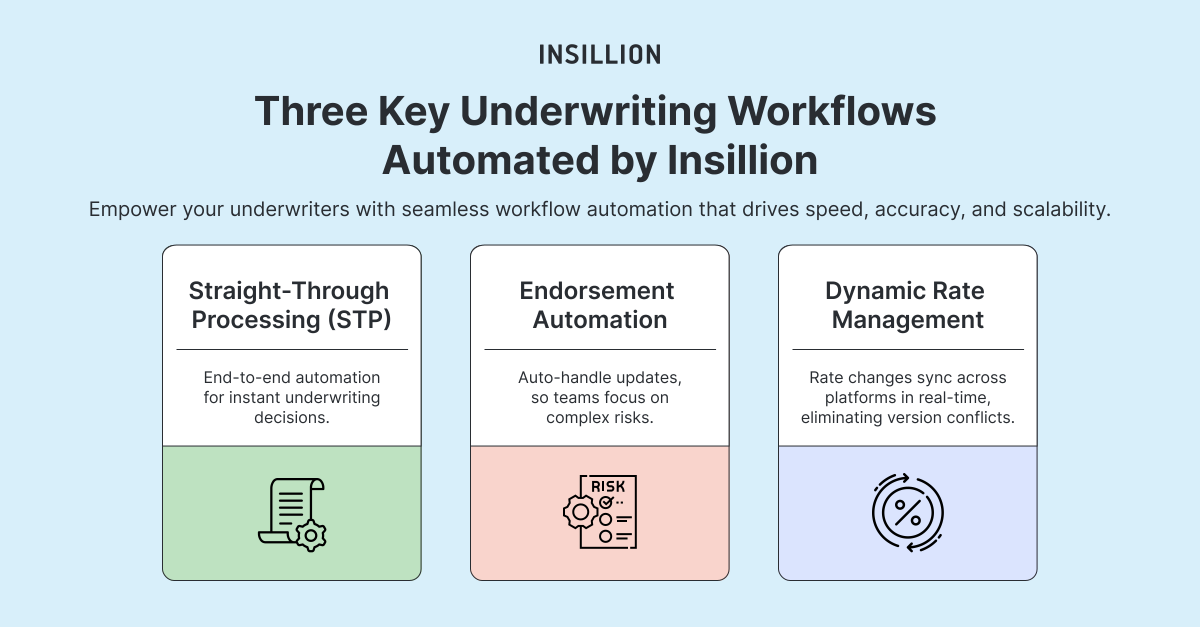
In this blog, we’ll explore three commercial insurance underwriting processes where the MGA software solution for personal and commercial lines is helping reshape P&C underwriting.
- Straight-Through Processing (STP) for new business submissions
- Endorsement automation for policy changes
- Dynamic rate management with Master Data Management (MDM)
While each workflow delivers measurable value, the greatest competitive advantage lies in speed, how quickly MGAs can assess risk, respond to brokers and agents, and deploy profitable rate changes.
Straight-Through Processing (STP): Automating Submission Intake
Straight-Through Processing (STP) has already proven its value in insurance. In underwriting, STP automates the entire journey, from submissions to policy issuance, without manual intervention. While STP is widely used in personal lines like auto, adoption in commercial insurance remains limited.
Commercial submissions often arrive in multiple formats, including PDFs, Excel spreadsheets, emails, ACORD forms, statements of values, and supplementals. That makes quick eligibility checks and clean data capture difficult without automation. This is especially challenging in the highly commoditized small and mid-market segment, where speed, consistency, and low-friction processing matter to both agents and insurers.
Manual processing slows low-risk cases and prevents underwriters from focusing on complex, high-value risks. The result? Slower turnaround times, inconsistent decisions, and higher operational costs.
How Insillion's Commercial Underwriting Platform Solves This
Insillion's commercial insurance underwriting software creates a balance between artificial intelligence and proven underwriting rules. Commercial and specialty insurers are increasingly investing in innovative technologies, particularly AI-driven tools, to keep pace with evolving market practices and gain a competitive edge in data access, pricing accuracy, and risk selection. This shift reflects growing pressure to maintain underwriting margins while scaling volume.
Today, 48% of insurers use STP for more than half of their underwriting transactions.
Modern underwriting software for insurance leverages AI and Intelligent Document Processing (IDP) to ingest submissions from email, portals, or APIs, classify incoming documents, and extract key data instantly from structured and unstructured formats.
The platform can automatically acknowledge incoming submissions, identify missing information, and assemble quote-ready files in minutes.
- High-volume, low-complexity cases flow through STP automatically, cutting decision times.
- Complex exceptions route to an underwriter’s queue with validated data attached, allowing specialists to focus on higher-value risks instead of paperwork. Dashboards also give underwriters visibility into weekly submissions, quotes, premiums, and referral workloads.
Insillion's Underwriting Summary Screen
Once a submission is ready for review, speed and clarity depend on how information is presented. Insillion's underwriting summary screen automatically consolidates submission data into a single, actionable risk view, giving underwriters instant access to key details such as:
- Risk information
- Coverage limits
- Premiums
- Property values
- TIV without reviewing multiple documents or screens
Configurable notes and remarks create a documented underwriting record that can be easily shared with carriers during approval workflows. Fully customizable to MGA-specific processes, the underwriting summary screen can display relevant information such as:
- Premiums
- Taxes
- Rates
- Claims data
Automating data aggregation and presentation, it reduces review time, improves consistency, and allows underwriters to focus on evaluating risk rather than managing administrative tasks.
Industry research shows that 95% of P&C policies will eventually flow through STP systems. According to Datos Insights, to achieve the required agility and 60–70% straight-through processing, insurers are moving away from monolithic core systems in favor of AI-driven underwriting workbenches that are modular, flexible, and API-enabled.
This results in a leaner operation that can handle a higher volume of policies without increasing headcount. It also lowers error rates, reduces rework, and improves broker response times.
Endorsements and Policy Servicing: Reducing Underwriting System Bottlenecks
Underwriters often spend disproportionate time handling routine policy endorsements, updating addresses, adjusting coverage limits, or adding locations. Though simple, these changes traditionally require manual rekeying across systems, premium recalculations, and document reissuance.
This creates backlogs and rising administrative costs at a time when commercial insurers are under pressure to preserve strong operating performance despite elevated claims severity and litigation trends.
How Insillion's Commercial Insurance Underwriting Software Solves This
Commercial insurance underwriting systems capture endorsement requests directly from agents and brokers, then apply predefined workflows to automate servicing.
Insillion enables MGAs to configure approval rules, authority thresholds, and routing logic so routine changes move faster while complex requests receive human review.
- Simple changes are auto-approved without underwriter intervention
- Complex adjustments are routed to the appropriate reviewer with complete audit trails
- Required documents are generated automatically
For multi-location policies, changes can be applied at either the policy level or the individual location level, depending on the product setup.
With automated underwriting systems, endorsement processing times shrink, error rates reduce, and rework is minimized. Faster servicing improves agent experience and retention, an increasingly important differentiator as competition intensifies across admitted and E&S markets.
A recent Deloitte survey showed that 68% of insurers are focused on technology that improves customer experience, with policy servicing automation ranking high on that list.
That experience, however, depends on more than automation. As Alexis Vaughn explains in the second edition of Insillion's MGA101 series, agents and brokers don't want a single point of contact when establishing a new appointment, they want direct access to the underwriter, claims leader, and salesperson supporting the account.
A common mistake is giving agents a dedicated sales contact without providing direct access to the underwriter. That doesn't reflect how agents work. When they need a limit increase approved or an endorsement issue resolved, they want to call the underwriter directly. Automation can accelerate routine tasks, but strong agency relationships still require a human connection.
Rate Changes and Master Data Management for Commercial Lines Underwriting
While STP and endorsements improve efficiency, rate agility is what truly defines underwriting competitiveness.
Actuaries and underwriters often maintain complex rating logic in Excel spreadsheets refined over the years. Traditional policy administration systems require long development cycles to implement even minor changes, delaying market response.
How Insillion's Commercial Lines Rating Software Solves This
Insillion’s Excel-to-API Product Builder converts spreadsheet-based rating models into governed, enterprise-ready rating services without losing institutional expertise.
- Rate updates are uploaded through CSV or Excel
- Maker-checker workflows validate changes
- Approvals include full audit trails
- Version-controlled deployment ensures consistency across channels
- APIs distribute rates to underwriting, portals, and downstream systems
As per Deloitte, this approach using commercial insurance rating software, reduces development time from 3–6 months to just 3–4 weeks to modify existing coverage.
Centralized master data management ensures consistent ratings across products, teams, and distribution channels. Underwriters can price faster, management gains stronger governance, and MGAs can react to market shifts with confidence.
Better Decisions Through Effective Underwriting Automation
The three workflows are interconnected parts of a unified commercial insurance underwriting strategy. McKinsey estimates that up to 40% of P&C carrier expenses are incurred in their top core processes, such as underwriting. At the same time, commercial insurers are ramping up investments in AI-driven analytics and automation to improve underwriting productivity, pricing precision, and risk selection.
Automated commercial underwriting solutions, combined with insurance rating APIs, allow rapid product development and distribution. Modern platforms like Insillion preserve Excel-based expertise while adding automation, controls, dashboards, carrier collaboration portals, document generation, and enterprise governance.
The result is faster quote turnaround, cleaner servicing operations, stronger underwriting discipline, and lower operating costs.
Transform your underwriting operations today with Insillion, one of the best commercial insurance underwriting software, featuring an Excel-to-API Product builder, Underwriting Suite, and Enterprise Rating.
Frequently Asked Questions
Author Details

Articles
Recent Articles
Loading recent posts...
Stay updated on
what’s relevant
