
Table of Contents
- Why P&C Insurance Automation Is Reshaping Commercial Lines
- The Traditional Certificate of Insurance Issuance Process
- How Insillion's Commercial Insurance Software Automates CoI Issuance
- Advanced Capabilities Beyond Certificate Generation
- Implementing an Automated CoI Issuance Solution
- Business Benefits of Automated Certificate of Insurance Issuance
- Choosing the Right Commercial Insurance Software for CoI Automation
- Frequently Asked Questions
- Author Details
Why P&C Insurance Automation Is Reshaping Commercial Lines
Commercial insurers are operating in an increasingly competitive market. As pricing softens across many property and casualty (P&C) lines, insurers are differentiating less on price and more on the quality of their service, coverage, and operational efficiency. Winning and retaining business today depends on providing self-service options and delivering a seamless experience for brokers and policyholders.
This shift is driving insurers to modernize manual processes across the policy lifecycle. Industry surveys consistently show that insurers are prioritizing P&C insurance process automation, AI, and process redesign to improve operational efficiency and reduce costs. Commercial insurance software solutions are helping insurers eliminate repetitive administrative work, so teams can focus on higher-value decisions.
One process that continues to rely heavily on manual effort is Certificate of Insurance (CoI) issuance. Although generating a certificate may appear to be a simple administrative task, insurers often issue hundreds or even thousands of CoIs throughout the life of a policy, making manual processes increasingly difficult to sustain.
For commercial insurance products like marine insurance, this challenge is particularly evident. Businesses that regularly transport goods typically purchase a Marine Master Policy (also known as an Open Cover Policy), which provides ongoing coverage for multiple shipments over a defined period.
In this article, we'll explore the challenges of traditional Certificate of Insurance issuance and show how Insillion's commercial insurance software enables CoI automation.
The Traditional Certificate of Insurance Issuance Process
A Marine Master Policy is the master agreement that sets the terms, coverage, and rating logic that will apply across a client's shipments for a defined period, often a year. But the open policy itself doesn't move cargo. Each shipment needs its own CoI, a document proving that specific consignment is covered under specific voyage and commodity terms at a specific value.
For a logistics company or a trading business that is shipping weekly or daily, this means the certificate, not the master policy, is the document they interact with constantly. CoI issuance is a routine but high-volume process, yet many existing commercial insurance quoting software are not designed to support the level of automation and scalability required to manage it efficiently.
Challenges With Traditional CoI Issuance:
Although the concept is straightforward, the operational process behind issuing certificates is often highly manual. Each time a shipment is ready to move, the broker or insured typically emails or calls the insurer with shipment details, including the invoice value, voyage information, commodity, and departure date.
The operations team then follows a series of manual steps to issue the certificate:
- Enter shipment details into a policy administration system or spreadsheet.
- Verify the applicable terms and conditions under the master policy.
- Calculate the premium or available policy balance, where required.
- Prepare the certificate and obtain the necessary internal approvals.
- Issue and send the completed certificate to the customer.
While this process may be manageable for occasional requests, it becomes increasingly difficult to sustain as certificate volumes grow. A single Master Policy can generate hundreds of CoIs over its lifetime, requiring operations teams to repeatedly validate policy terms, process shipment information, track policy utilization, prepare certificate documents, and perform quality checks before every issuance. These repetitive administrative tasks consume valuable operational time, increase dependency on manual processes, and limit an insurer's ability to scale efficiently.
Operational Impact on Insurers, Brokers, and Customers
Manual CoI issuance creates operational challenges for every stakeholder involved.
- For insurers, repetitive data entry increases the risk of errors while creating significant administrative overhead. Operations teams must manually monitor premium utilization, policy limits, and certificate history, often across spreadsheets or disconnected systems. Without centralized visibility, maintaining accurate records and tracking certificate status becomes increasingly difficult.
- For brokers, manual workflows result in longer turnaround times and frequent follow-ups to check the status of certificate requests. During periods of high shipment activity, these delays place additional pressure on operations teams and affect service levels.
- For policyholders, delays in certificate issuance can disrupt business operations. In shipping voyages, for example, cargo often cannot move until the required CoI has been issued. Any delay in generating the document can postpone shipments and lead to unnecessary costs.
Manual processing also limits auditability. Tracking who issued a certificate, when it was generated, what changes were made, and how much of the master policy limit has been utilized often requires significant manual effort. As shipment volumes continue to increase, these operational inefficiencies make traditional CoI issuance increasingly difficult to manage, reinforcing the need for P&C insurance automation built specifically around high-volume, policy-linked documents.
Clients and brokers increasingly expect the same seamless, personalized digital experiences they encounter in other industries from insurers. At the same time, the growth of Insurtech is raising competitive pressure by addressing long-standing customer pain points through digital-first solutions.
How Insillion's Commercial Insurance Software Automates CoI Issuance
Automation, and cloud technologies are enabling insurers to deliver scalable, cost-efficient services, particularly for commercial and small-business portfolios. Cloud-driven SaaS P&C insurance core platforms are helping to unlock leaner, more automated processes, supported by data-driven decision engines. Insillion transforms CoI issuance from a manual, document-driven workflow into a secure, self-service digital process.
As one of the leading commercial insurance software for MGAs, carriers, and program administrators, Insillion enables authorized users to create CoIs directly against an existing Master Policy while automatically enforcing business rules, underwriting controls, and policy limits.
Secure, Self-Service Access to the CoI Portal
McKinsey found that around 65% of small commercial insurance buyers are willing to purchase insurance through direct or virtual channels. In contrast, more than 8 in 10 large commercial insurance decision-makers consider customer-centricity a high or top strategic priority. These trends are driving insurers to adopt secure self-service solutions across the policy lifecycle, including CoI issuance.
Once a Marine Master Policy has been issued, Insillion enables secure, self-service access to the CoI portal for authorized brokers and corporate customers. Access is managed through configurable Access Control Lists (ACLs), ensuring only approved users can issue certificates against a specific Master Policy.
The self-service portal also allows users to view multiple active Master Policies under a single account and select the appropriate policy when issuing a new CoI. By putting certificate issuance directly into the hands of authorized users, insurers can reduce reliance on operations teams while delivering the speed, convenience, and self-service experience today's commercial insurance customers expect.
Master Policy-Driven Certificate Generation
Instead of re-entering policy information for every CoI request, agents/brokers/shipping companies simply select an existing Master Policy, and Insillion pulls in the relevant details automatically: policy number, coverage period, broker information, valuation basis, rates, clauses, and other predefined values.
Mechanically, this works through named data fields from the master policy's start and end dates, policy number, and broker ID, among others, that pull directly from the linked Master Policy and can be hidden from the certificate-issuing user entirely. Commercial insurance software solutions like Insillion eliminate repetitive data entry and close a major source of manual error.
Accenture's research found that small business owners purchasing commercial insurance increasingly expect faster, simpler, and more digital experiences, while lengthy administrative processes continue to be a major source of frustration.
Shipment-Level Data Entry Only
Because policy information is automatically inherited, agents/brokers/shipping companies only enter shipment-specific details such as invoice information, commodity description, departure date, destination, and other voyage-related information. Everything else, such as terms, rates, and coverage basis, is already locked in from the master policy. This significantly reduces the amount of information required to generate a certificate while ensuring every CoI remains aligned with the terms of the underlying Master Policy.
Automated Underwriting Controls
According to McKinsey, more than 80% of the insurance leaders in their survey cited maintaining underwriting discipline as a top three challenge. Automation does not replace underwriting; it strengthens it. As per BCG's report "Insurance 2025: Adapting to a New Era of Opportunities and Challenges," industry leaders are creating cross-functional coordination and efficiency by deliberately adopting operating models with clear lines of accountability and appropriate levels of automation.
Insillion applies configurable business rules during issuance, automatically flagging situations like:
- Policy Start Date Backdating beyond 30 Days to 60 days
- Blacklisted From/To Country
- Blacklisted From/To Origin Port/Airport
- BL/AWB/LR/RR/CNN Date
- Incidental charges > 10%
If a CoI request triggers any of these rules, it is automatically referred to an underwriter for review before the certificate can be issued. The commercial insurance platform also enforces user access and policy limits throughout the issuance process. Level-based permissions ensure that only authorized users can generate certificates, while the system continuously validates the available balance under the Master Policy.
Each issued certificate deducts from the predefined policy limit (or deposit balance), and if the requested certificate exceeds the remaining available limit, the system prevents it from being issued.
Support for Multiple Marine Scenarios
Not every insurer reports shipments the same way. Insillion supports standard certificate generation, declaration uploads, and STOP-style periodic declarations, with self-service issuance available to brokers or corporate clients across all of them so insurers aren't forced to change their operating model to adopt automation.
Advanced Capabilities Beyond Certificate Generation
Insillion extends beyond certificate generation by providing capabilities that simplify endorsements, declaration of management, and third-party system integrations, enabling insurers to manage the entire Master Policy process from a single platform.
Financial Endorsements and Policy Updates
Insillion enables authorized users to initiate both financial and non-financial endorsements through a self-service portal, reducing dependence on insurer operations teams. P&C insurance platforms like Insillion automatically validate each request against the Master Policy and configured business rules.
Financial endorsements, such as increases to the sum insured, trigger automatic premium recalculation, online payment, and endorsement generation. Non-financial endorsements update policy details and generate the revised endorsement document with minimal manual intervention. By automating the endorsement lifecycle, Insillion accelerates turnaround times, reduces administrative effort, and maintains insurer-defined controls and governance.
Declaration Uploads and STOP Workflows
Different insurers allow different methods for reporting shipments under a Master Policy. While many organizations issue individual certificates for each shipment, others use periodic declaration models such as STOP (Sales Turnover Policy) declarations. Commercial insurance software like Insillion supports multiple operational models, allowing insurers to generate individual certificates, upload shipment declarations, or process periodic declarations through configurable workflows.
Integration with Enterprise Systems
Marine insurance involves multiple stakeholders, so it's essential to be integrated with them to reduce manual work. Insillion integrates with external platforms and APIs to reduce duplicate data entry and improve data consistency across the insurance ecosystem. Depending on business requirements, integrations may include:
- Core policy administration systems
- Customer databases
- Payment gateways
- Other third-party applications
By connecting these systems, insurers can automate data exchange, improve operational efficiency, and reduce manual intervention throughout the CoI lifecycle.
Implementing an Automated CoI Issuance Solution
The commercial insurance industry is rapidly automating manual workflows. EY reports that generative AI can reduce quote-to-bind timelines by up to 75% and pre-submission interactions by 50%. Implementing a P&C insurance platform for commercial lines begins with configuring the Master Policy (Open Cover/Open Policy) and the associated CoI product. Together, they establish the foundation for secure, policy-driven certificate issuance.
During implementation, insurers configure the Master Policy by defining its validity period, rating logic, policy limits, and configurable business rules. This creates the framework against which individual CoIs are issued and managed. The CoI product is then linked to the Master Policy and configured to inherit relevant policy information automatically, a configuration-first approach that reduces time-to-market.
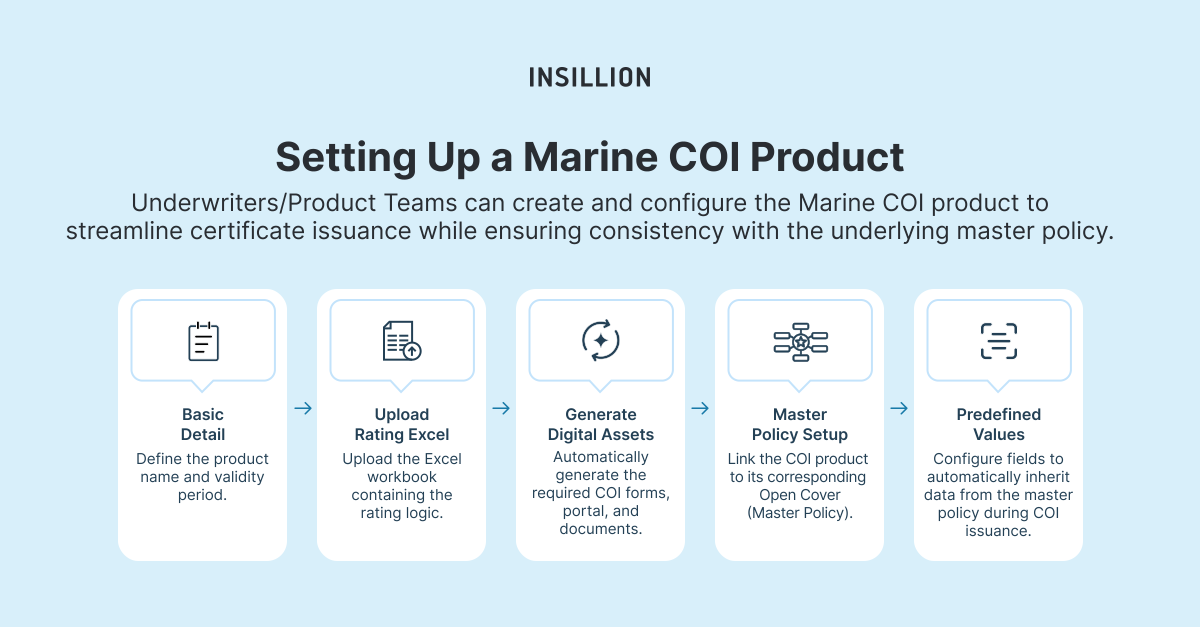
Insillion ensures every certificate remains aligned with approved coverage, terms, and policy limits while minimizing manual data entry. Once implementation is complete, authorized users can issue a COI through a guided, self-service workflow.
Here are the steps involved in COI Automation:
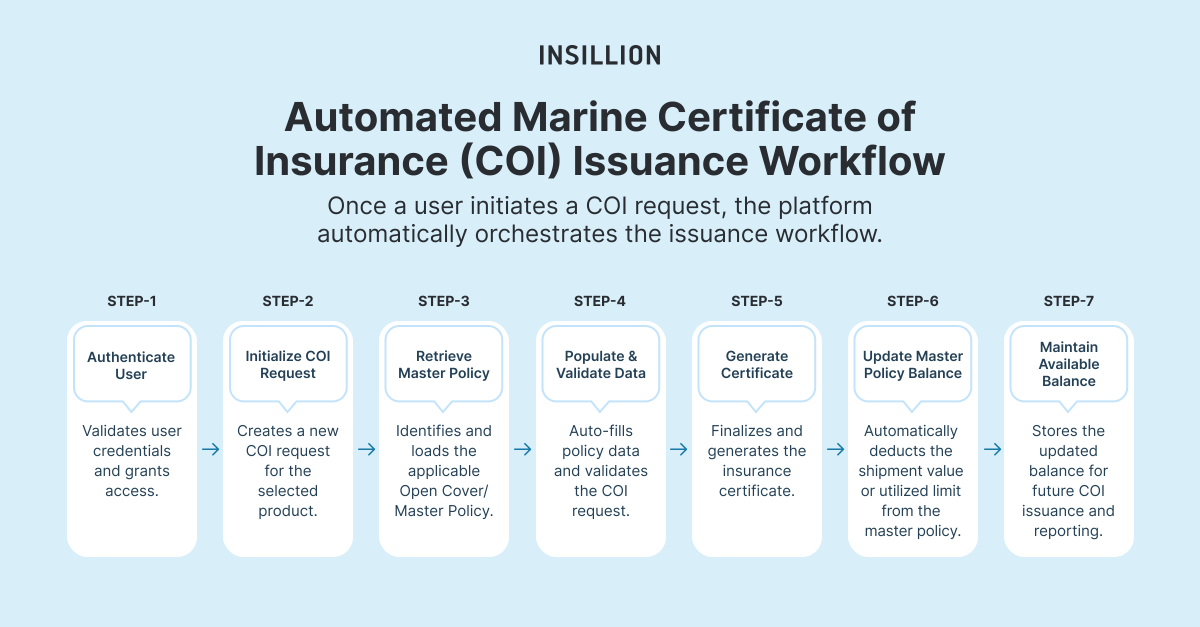
Implementation timelines vary based on business complexity, data migration requirements, and integration needs. Standard implementations typically take 3–4 weeks, while larger deployments involving complex integrations or extensive data migration generally take 4–8 weeks.
Business Benefits of Automated Certificate of Insurance Issuance
As per BCG's report "Insurance 2025: Adapting to a New Era of Opportunities and Challenges," to successfully deploy AI at scale and capitalize on the impact of AI on business, insurers must act boldly and utilize a 10-20-70 approach that emphasizes algorithms (10%), tech and data (20%), and people and processes (70%).
- Faster operational turnaround: With policy information automatically inherited from the master policy and certificates generated digitally, issuance that once took weeks can often be completed within days.
- Improved audit efficiency: By automatically populating policy details from the linked Master Policy and enforcing configurable business rules, Insillion's P&C insurance platform improves data accuracy while ensuring certificates remain consistent with approved policy terms backed by a complete audit trail.
- Better Broker and Customer Experience: The self-service CoI portal puts certificate issuance directly into the hands of authorized brokers and policyholders, allowing them to generate Certificates of Insurance whenever required while maintaining insurer-defined controls and governance.
- Greater Operational Efficiency and Scalability: Teams spend less time on repetitive document preparation and more time on underwriting, customer service, and handling higher volumes of CoI requests without proportionally increasing administrative effort.
- Reduced TCO: Reducing manual effort lowers the cost of certificate generation, tracking, and corrections, while improving accuracy minimizes errors, disputes, and rework. Faster CoI issuance also helps avoid shipment delays, reducing the risk of demurrage charges and idle assets in marine insurance, a concrete example of commercial insurance risk digitization paying off in operational terms.
Choosing the Right Commercial Insurance Software for CoI Automation
Certificates of Insurance play a critical role in many commercial insurance products. While Marine Master Policies provide a practical example of these challenges, the same principles apply across many insurance products where Certificates of Insurance are issued at scale. Modern commercial insurance software like Insillion enables insurers to transform CoI issuance into a secure, automated, and self-service process. Automating CoI issuance not only streamlines operations but also creates a better experience for brokers, customers, and internal teams alike.
Frequently Asked Questions
Author Details

Articles
Recent Articles
Loading recent posts...
Stay updated on
what’s relevant
