
Table of Contents
- Galaxy Health Insurance Recognition for Fastest Greenfield Implementation
- Building a New Health Insurer in a Competitive Market
- What Makes Greenfield Implementations Different in Insurance?
- A Dual-Greenfield Approach to Insurance Technology
- Building a Reusable Foundation for Future Product Launches
- Three Priorities for Greenfield Insurance Implementations
- Building a Future-Ready Insurance Carrier Through Greenfield Implementation
- Frequently Asked Questions
- Author Details
Galaxy Health Insurance Recognition for Fastest Greenfield Implementation
On October 9, 2026, at Galaxy Health Insurance’s headquarters, Insillion presented Galaxy Health Insurance and its IT team with the “Fastest Greenfield Implementation” award, recognizing the joint effort to implement the Insillion platform in under six weeks.
The implementation involved close collaboration between the Galaxy and Insillion teams. Insillion thanks the Galaxy Health Insurance leadership team: Srinivasan Gopalan, MD & CEO; Margabandhu Radhakrishnan, Chief Underwriting Officer and Head of IT; Guru Prakash, Chief Marketing Officer;
Galaxy Team: Gauri Venkatesan, Chief Risk Officer; Sankaranarayanan Ponnusamy, Deputy Chief Technology Officer; Pandiaraj Lakshmanaperumal, Head – Digital Applications; and the wider Galaxy Health Insurance IT team for their contributions to the project.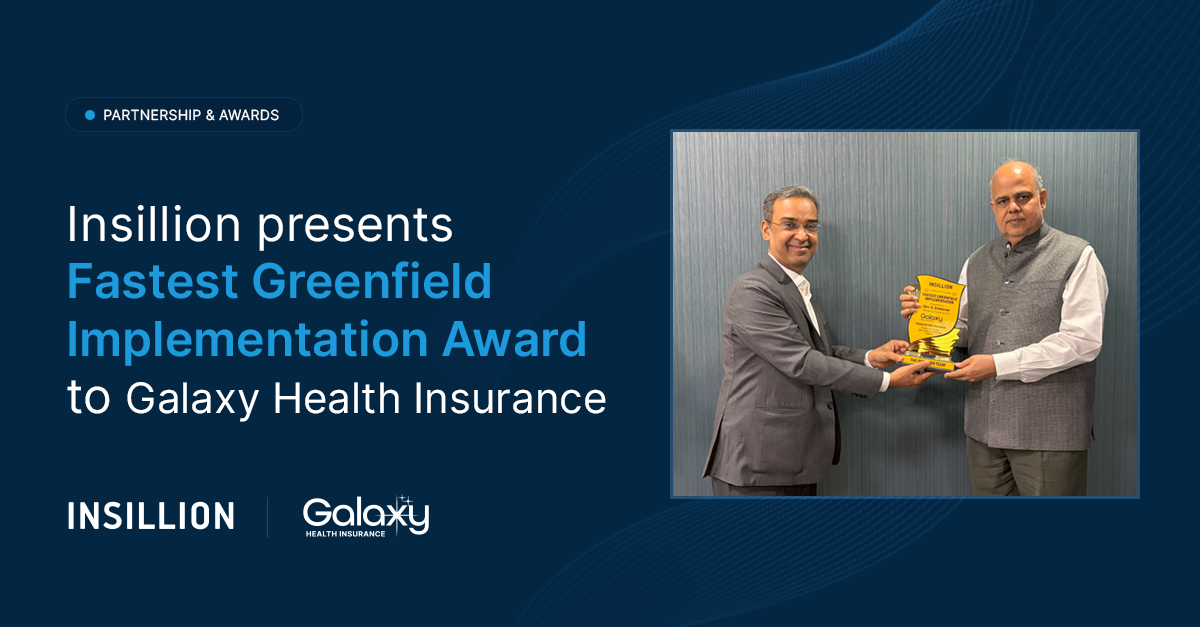
Beyond the initial go-live, the implementation established a technology foundation designed to support Galaxy’s product development and distribution requirements as its business grows.
Building a New Health Insurer in a Competitive Market
The India health insurance market size in terms of GWP is projected to grow at a CAGR of 20.9% from 2025 to 2030. The India health insurance market size in terms of New Business Premium (NBP) is anticipated to expand at a CAGR of 21.4% from 2025 to 2030.
As a new entrant in an established market, Galaxy needed technology to support its initial product launches while accommodating future changes to its portfolio and distribution strategy, including;
- Developing and expanding its health insurance product portfolio.
- Reaching different customer segments through multiple distribution channels.
- Adapting products and business rules as requirements evolved.
- Bringing products to the market without creating unnecessary dependencies on custom development.
Health insurers often need to tailor products to different customer segments, distribution partners, and sales channels. When each variation requires custom development, expanding a portfolio can increase implementation time and resource requirements. Configurable health insurance software systems can help address this challenge by separating product and distribution capabilities from core insurance operations. This allows insurers to adapt business-facing capabilities while maintaining integrations with the core system.
Galaxy implemented Insillion alongside its core system from the outset, establishing this separation as part of its initial technology architecture.
What Makes Greenfield Implementations Different in Insurance?
A greenfield implementation lets a new insurer make architectural decisions before customizations and dependencies accumulate.
In some traditional implementations, insurers establish their core system first and subsequently add product requirements, business rules, and digital journeys. Depending on the system architecture, these additions can drive further core customization, especially when product and distribution capabilities are closely coupled with core operations. Over time, this coupling can make certain changes more complex to implement. Introducing a product variation or supporting a new distribution journey may require changes across multiple connected components.
A greenfield implementation allows insurers to define these responsibilities from the beginning:
- Core operations: The core system supports core back-office processes.
- Product configuration: Product structures, rating parameters, and underwriting rules can be managed in a configurable layer.
- Digital channels and partner connectivity: Agent, broker, and customer applications can use shared APIs and integrations to access relevant product and policy workflows.
This separation does not eliminate the need for core integration. Instead, it establishes clearer boundaries between systems, allowing changes to business-facing capabilities without requiring corresponding core changes in every instance.
A Dual-Greenfield Approach to Insurance Technology
In Galaxy’s implementation, the health insurance core system and Insillion were implemented in parallel and went live together. This dual-greenfield approach established distinct responsibilities for each system while connecting them through APIs.
The core system serves as the system of record for back-office operations. Insillion provides a configurable layer for product setup, rating, underwriting workflows, and distribution experiences, with integration to the core through APIs and reusable components.
This architecture supports three important outcomes.
- Stability: Keeping product and distribution capabilities decoupled from the core can reduce the need to customize the core for every business-facing change. The core can continue supporting its primary operational responsibilities while the configurable layer accommodates evolving product and distribution requirements.
- Agility: Product set-up, underwriting workflows, and distribution journeys can change as an insurer enters new segments or responds to market requirements. Insillion’s low-code configuration allows many of these changes to be implemented through configuration rather than requiring custom development for every variation.
- Scalability: Agent, broker, and customer applications can use shared Insillion APIs and common underlying services. This helps maintain consistent product rules and workflows across channels and provides a single source of truth for making changes.
Building a Reusable Foundation for Future Product Launches
A greenfield architecture can also support reuse across subsequent launches. Instead of treating each new product or integration as a separate implementation, insurers can build on top of existing configurations and integration components.
- Product cloning: Existing insurance product configurations can serve as the starting point for new variations. Insurers can adapt relevant parameters and rules rather than configure every product from scratch, reducing repetitive work where products share common requirements.
- Reusable core integrations: Integrations developed for the initial implementation can be reused for subsequent products and workflows where the underlying requirements remain consistent. This can reduce duplicated development work and support more predictable implementation timelines.
The distinction is between launching the first product quickly and establishing a repeatable process for later launches. Reusable configurations, integrations, and workflows can help reduce the effort required as the product portfolio expands. For a greenfield insurer, this means evaluating not only the time needed to launch the first product but also how the technology architecture supports subsequent launches.
Three Priorities for Greenfield Insurance Implementations
- Design for subsequent launches: The first go-live is one milestone in a longer product roadmap. Insurers should consider how product configurations, integrations, and workflows can be reused when launching additional products, rather than treating every launch as a separate implementation.
- Separate stability from agility: The core system and the product and distribution layers serve different purposes. Establishing clear responsibilities can help insurers maintain operational continuity while adapting products, workflows, and digital experiences as business requirements change.
- Design distribution technology alongside products: Distribution channels influence how insurance products are presented, purchased, and serviced. Planning product configuration and channel journeys together can help insurers extend distribution to new partners while reusing existing product rules and workflows.
Building a Future-Ready Insurance Carrier Through Greenfield Implementation
The success of a greenfield insurance implementation depends not only on how quickly an insurer goes live but also on how well its technology foundation supports subsequent launches and changing business requirements. For insurers embarking on a greenfield journey, the architectural decisions made at the outset can influence how efficiently the business responds to future product and distribution requirements.
Galaxy and Insillion established an architecture that combines a core system with a configurable product and distribution layer. Insillion’s low-code configuration, API-based core integration, and reusable product capabilities provide Galaxy with a foundation to introduce product variations, extend distribution, and adapt to evolving business needs.
Insillion thanks Galaxy Health Insurance and its IT team for their collaboration throughout the implementation and looks forward to supporting Galaxy’s continued growth.
Frequently Asked Questions
Author Details

Articles
Recent Articles
Loading recent posts...
Stay updated on
what’s relevant
